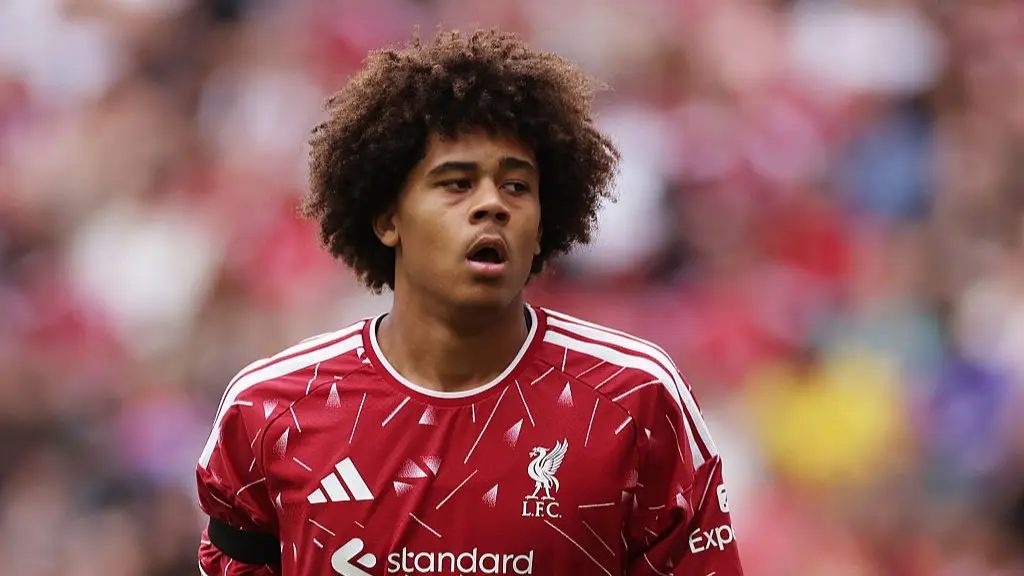
How new Liverpool wonderkid can still play for club this season as strict rule forces loan move

Liverpool fans were impressed with 18-year-old defender Ifeanyi Ndukwe in the Reds’ 3-2 loss against AS Monaco, but they were not pleased to learn that the Austrian cannot represent the club in competitive matches; however, there appears to be a solution.
Andoni Iraola managed Liverpool at Anfield for the first time on Sunday (August 9), with first-half strikes from Alexander Isak and Florian Wirtz handing the home side a two-goal buffer before the half-hour mark.
However, Alexander Golovin’s penalty pulled one back for the Ligue 1 outfit on 44 minutes before Mika Biereth and Paris Brunner made it 3-2 to the away side, leaving those inside Anfield scratching their heads.
And despite the negative result, Iraola had plenty of reasons to be optimistic, with youngsters Lewis Koumas and Ndukwe impressing.
Advert
The latter played the first 45 minutes and appeared composed in possession before he was replaced by Wataru Endo.
READ NEXT: Every Premier League 26/27 home shirt rated as two clubs score perfect 10/10s
The teenager, who stands at six feet and six inches and signed for £2.6million from Austria Wien in January, can only play once more for Liverpool – in the pre-season friendly against Como on Sunday (August 16) – this term due to him missing out on reaching the points target to qualify for a UK work permit.
How Ifeanyi Ndukwe can play for Liverpool this season
In previous years, he may have been able to take up the Elite Significant Contribution (ESC) squad slot, which can be awarded to players through the standard Governing Body Exemption, but a rule change means the criteria for Premier League clubs are assessed based on international appearances at both senior and youth level, as well as other criteria.
According to Liam Henshaw, Data Analyst and Scout at Unique Sports Group, “When a club wants to sign an overseas player, that player needs permission to work in the UK. The Football Association issues a Governing Body Endorsement (GBE) to say the player meets the standard, and the club then uses it to get a work permit from the Home Office through the points-based system.”
Players receive an Auto Pass if they have played football for a strong enough nation.
Henshaw added: “It's judged on the percentage of their nation's competitive internationals they've featured in, set against that nation's FIFA ranking. A regular for a top-ranked country passes easily. A fringe player for a lower-ranked one won't.”
If a player does not receive an Auto Pass, then they need to achieve 15 points or more based on the criteria set out, including domestic league minutes, continental minutes, international appearances, final league position and continental progression.
“If a player doesn't auto pass, the club needs to show they score 15 points or more across a set of criteria,” he added. “Land between 10 and 14 points and the club can pay for an independent Exceptions Panel to argue the case. Below 10 and, in most cases, that's the end of it for that window.”
So, in order for Ndukwe to qualify, it may be wise for him to go out on loan to a Band 1 or Band 2 league, which in theory would earn him points to receive the GBE from the FA, allowing Liverpool to obtain a work visa.
Band 1 leagues include the Premier League, Bundesliga, La Liga, Serie A and Ligue 1, while Band 2 is made up of the Portuguese Primeira Liga, Eredivisie, Belgian First Division A, Brazilian Serie A and English Championship.
“The single biggest lever for most players [is domestic league minutes],” Henshaw explained.
“Points are awarded on the percentage of available league minutes played, scaled by the league's band. Playing 90-100% of minutes is worth 12 points in a Band 1 league, 10 in Band 2, 8 in Band 3, 6 in Band 4, 4 in Band 5 and 2 in Band 6. It slides down from there as the minutes drop, and below 30% of minutes you get nothing.”
Mor Talla Nidaye has reportedly taken the spare ESC slot. This means Ndukwe will not be eligible to play for Liverpool until at least 2027.
Topics: Liverpool
 Luke Davies