‘We could hear the police sirens’ - What it was really like inside infamous West Ham vs Millwall riot

If you asked any football fan to name the biggest rivalries in UK football, there is a good chance they would name Millwall vs. West Ham right at the very top.
It is one of the longest-standing rivalries in the sport, first played in 1899 between Thames Ironworks and Millwall Athletic. This Saturday will see the 100th iteration of the Dockers Derby, the first time the clubs have met since they faced each other in the Championship back in 2012.
The rivalry is deeply embedded in British football hooliganism and has been depicted in both books and films about the subject, often used as a stereotype for football's ugly past. And for good reason. There have been notable violent incidents between supporters, resulting in the death of a Millwall fan in 1976 and the murder of a West Ham fan in 1986. Then there was the 2009 Upton Park riot, a match so infamous that it has its own Wikipedia page.
The 2009 Upton Park riot
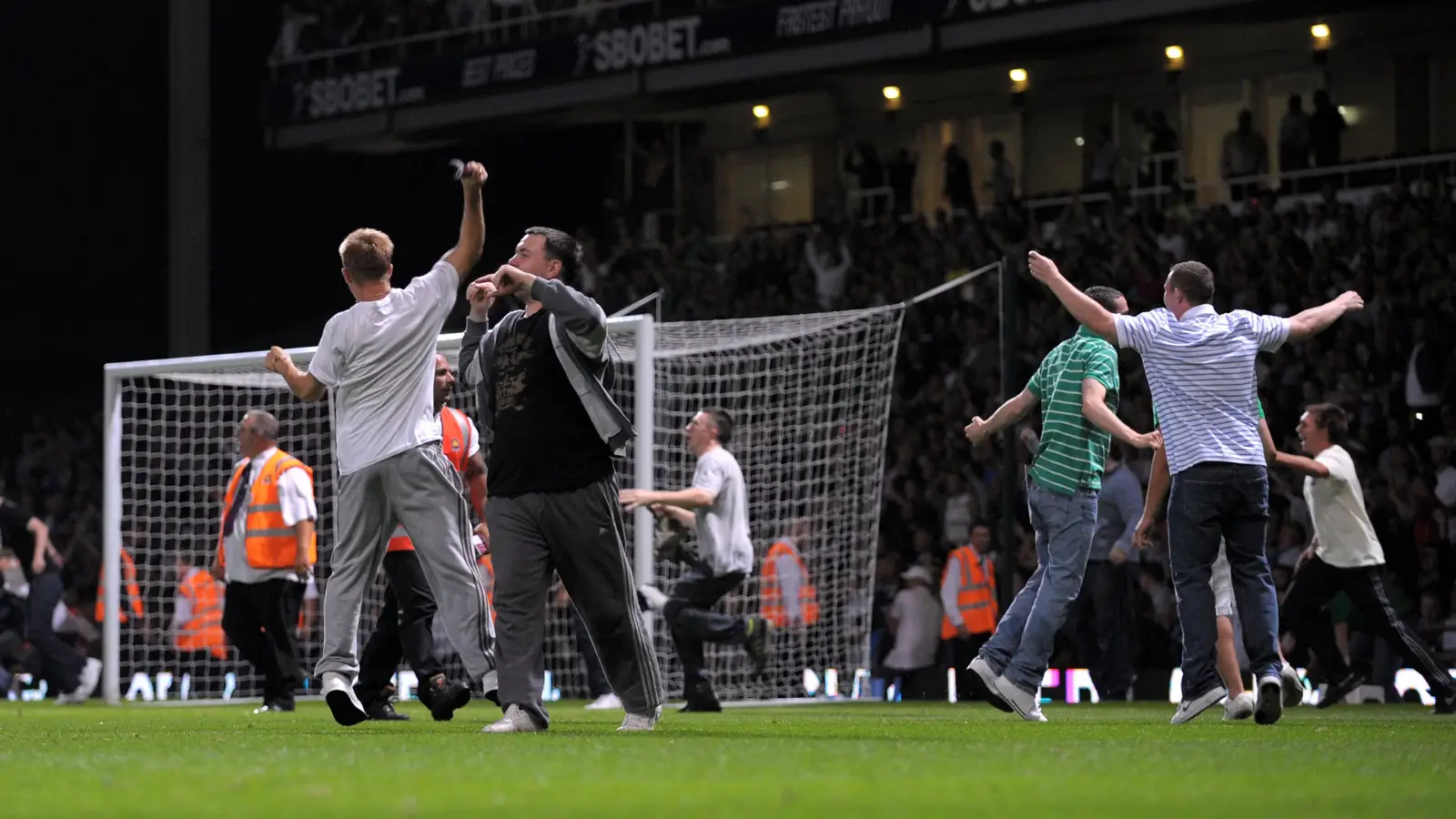
West Ham won the League Cup second-round match 3-1 after extra time, but the encounter is best remembered for the several pitch invasions and acts of hooliganism that saw 20 people injured and a Millwall fan stabbed. Harry Redknapp suggested the two clubs should never be allowed to meet in a cup match again after both were charged by the FA for numerous offences, 80 supporters were arrested and West Ham handed lifetime bans to 54 of them.
Gavin Muge was the assistant referee that day and knew it would be a match like no other from the second he was told how he would be getting there.
Advert
"I've been going to football for a long time, and I thought that was going to be tasty," Muge told SPORTbible, in association with Play at Lucky Casino. "We were told as match officials of a few changes to routine procedure. Normally, we would go to the game by ourselves, claim mileage for travel, drive the car, all that type of stuff. But this particular game, we were told, 'No, you ain't doing that. Drive to a hotel in Dartford, meet up there, and we'll escort you in on a minibus.'
"When we were being driven in, shopkeepers were putting up protective barriers on their glass windows, and outside Upton Park Stadium was a statue of Bobby Moore, Jeff Hurst, Martin Peters. It was being boarded up.
"From two or three miles away, we could hear the police sirens. We could feel the atmosphere. When we got to the stadium, we walked onto the pitch, and a police officer came up to us and said trouble had already started outside. He told us he could do with this game being low-key. There were 500 police on duty for this game; even at a high-stakes Premier League game, you might have 100."
With such a volatile atmosphere anticipated, Millwall's away allocation was cut in half from the standard 10% allowed by the competition, but it didn't necessarily make it any safer.
"It also meant that 1,500 people that would have been in the ground, under supervision, were outside the ground, without supervision," Muge added. "As the whistle went, this wasn't just your typical League Cup second-round tie. Looking around the crowd, it was noticeably different to a normal crowd because there were fewer kids with shirts on, fewer families with scarves, and there were more blokes dressed in casual gear.
"As we led the players out, there was tension amongst the players, not with each other, but they could perceive how the atmosphere had built up."
It might be surprising to hear, but the actual match went along without too much incident. Muge recalls that the action was not too different from a typical derby match and that the officials did well to keep the game flowing, diffusing flashpoints as best they could.
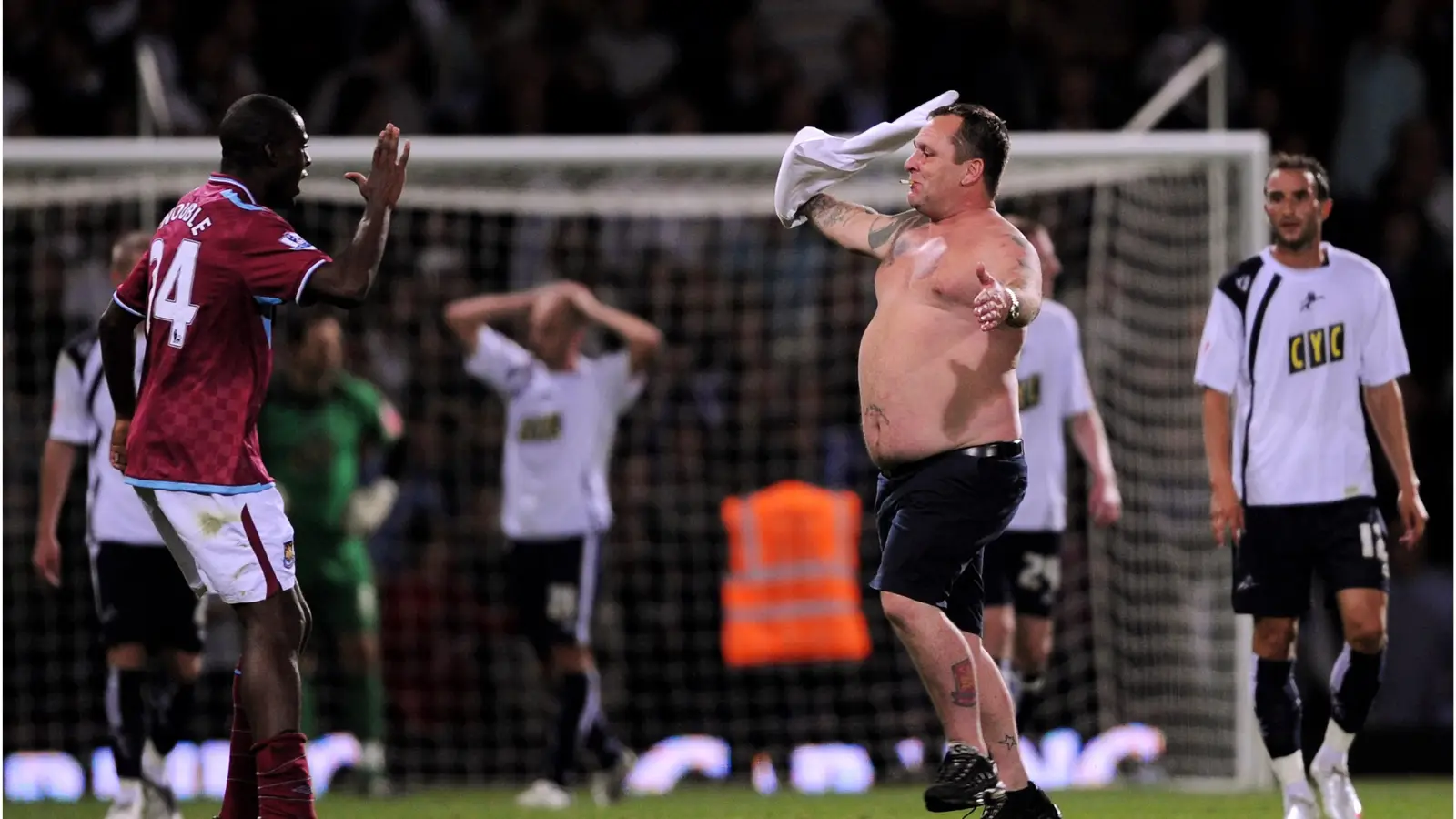
That was until the dying moments of normal time. Millwall had taken a first-half lead through club legend Neil Harris and looked on course to book their place in the next round when Junior Stanislas netted a late equaliser for the home side, sparking the first of several pitch invasions.
"When people came on the pitch, they sort of ran past my shoulders," Muge recalled. "I had my back to the stand. They ran past my shoulders. They never came anywhere near me. They sort of immediately came onto the pitch, got their phones out, turned right to go to the away end, and then started filming everything."
As the West Ham fans goaded the gutted away end, the West Ham players begged them to return to the stands so they could carry their momentum in search of a winner. Instead, the match went to extra time, with another half an hour required to separate the two sides.
Eight minutes after the restart, West Ham finally took the lead when Stanislas fired in a penalty after a handball in the box. This time, an even bigger pitch invasion followed, as supporters from all stands found their way onto the pitch and the Millwall players were forced to retreat to the dressing room.
"It was very difficult for security. It wasn't because of us that there was a pitch invasion in terms of our performance on the day. It was actually quite good. We were all mic'd up and were able to talk to each other from a distance. The referee, Paul Taylor, told us to stand in the centre circle and stay there, because the fans weren't bothered by us. They just wanted to get at each other."
As the match descended into chaos, calmness was required from the officials. They knew that if the police could clear the pitch, it would be in everyone's best interests for the game to continue and be completed in an orderly manner.
"We wanted to complete the game. If the game had been abandoned, there would have been chaos because you then have, at a second's notice, 25,000 people hitting the street. The trains, the underground trains, wouldn't have been ready. The police wouldn't have been in the right places. Abandoning the game was really a low option."
After a lengthy delay, the match resumed, and West Ham wrapped it up two minutes later through Zavon Hines. The Millwall players could be forgiven for feeling hard done by after conceding so soon after returning to the field following the pause in action, but the officials knew they had done all they could to get the match completed.
It didn't make getting home any easier, though.
Muge added: "As long as it ends through no fault of yours and ends safely, it just needs to have a fair-play finish. I didn't care who won, who scored. I just wanted the referee and my performance to be good on the night.
"It did finish late. We were taken to the dressing room afterwards, kept in there for a bit while the stadium was cleared. We didn't leave Upton Park until after midnight. Even then, our minibus was forced to follow the Millwall team bus because it meant they only needed one police escort, rather than two. By the time we got back to the Dartford hotel and drove home, it was 3 a.m. I slept for two hours and was in work the next morning."
Muge and his colleagues were asked to contribute any circumstantial evidence to the subsequent FA inquiry, as the government's sports minister, Gerry Sutcliffe, labelled the violence "a disgrace to football."
The Metropolitan Police said it was an isolated incident and not a signal that football violence was returning. For Muge, it remains the one night he is asked about more than any other in his nine-year career as a linesman.
He remembers it more fondly than you might think.
 Rich Fay