
Scotland Player Barred From Celebrating World Cup Qualification With Teammates

One Scotland player was effectively blocked from celebrating his side’s 4-2 win over Denmark, which secured World Cup qualification.
Scott McTominay’s acrobatic bicycle kick opened the scoring on a historic night for Scotland, but in typical fashion, the side did not make it easy for themselves.
Visitors Denmark hit back through a Rasmus Hojlund penalty on 57 minutes before the home side went 2-1 up through Hearts forward Lawrence Shankland with 12 minutes left.
But the Scandinavian outfit hit back via Manchester United left-back Patrick Dorgu, levelling the scores at 2-2 with just nine minutes remaining.
Advert
Then, to the delight of nearly 50,000 Scotland fans inside Hampden Park, Celtic left-back Kieran Tierney curled a long-range strike past Denmark goalkeeper Kasper Schmeichel to make it 3-2 on 93 minutes before Kenny McLean’s strike from his own half secured the win and Scotland’s place at their first World Cup since 1998.
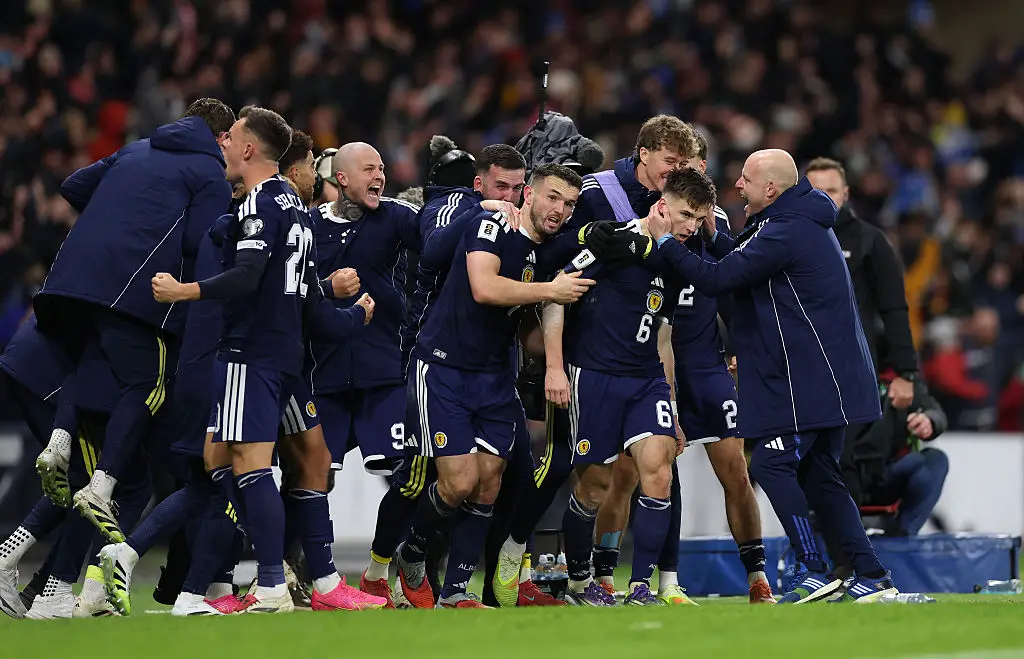
As you’d expect, jubilant scenes ensued on the pitch and in the stands with goalscorer Tierney describing the win as being “one of the best feelings ever”.
Forty-two-year-old veteran goalkeeper Craig Gordon, who has played for Scotland for 21 years and admitted that he almost retired last summer, described the moment as being worth all the disappointments he has experienced.
The celebrations will no doubt continue for some time, with fans likely organising their trips to North America already.
However, one unlucky Scotland star did not get to enjoy the celebrations in the same way as his teammates.
Midfielder John McGinn played every minute of the game, and despite being in the thick of the celebrations on the pitch, he was momentarily blocked from the players’ dressing room as he underwent a drug test.
The Aston Villa man took to social media and alongside a photograph of himself wrote: “Drug test not allowed in the changing room, can’t write it.”
According to UEFA regulations, players may have blood and urine samples collected in competitions - including at training, at home and following matches.
Samples are then analysed for banned substances such as steroids, EPO, growth hormones and prohibited stimulants.
Players are also selected for a doping control test by a random draw or via UEFA targeting.
Random selection is made by a system as soon as the teamsheets are submitted, with two Doping Control Officers (DCOs) usually in attendance for the tests.
UEFA’s rules state: “After notification, players must report directly to the doping control station. They are permitted to give flash interviews in the tunnel area but may not return to their dressing room. If a player needs personal belongings or a change of kit, the team doctor or other team representative can bring these to the doping control station.”
 Luke Davies