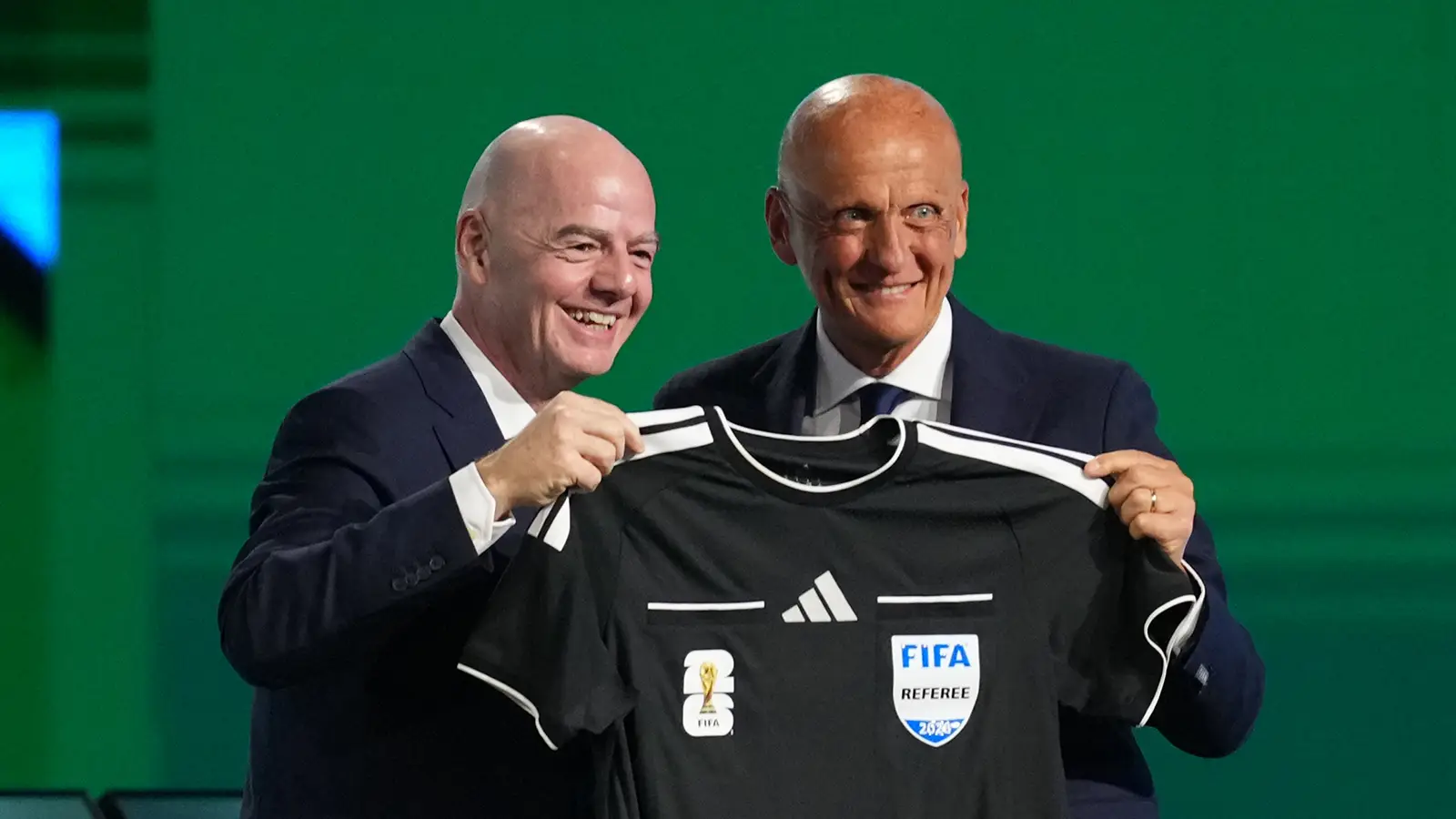
New World Cup rules reviewed by Pierluigi Collina as one area sees 'dramatic decrease'

Pierluigi Collina has given a review of the refereeing standards at the 2026 World Cup and revealed a dramatic decrease in one area.
The 2026 showpiece has broken new ground with a whole host of different rules, varying from much-maligned hydration breaks lasting three minutes in each half to players receiving red cards for covering their mouth in a confrontational manner.
Miguel Almiron of Paraguay was the first player to be sent off for the action after a VAR review, before Arsenal's Piero Hincapie was sent off in the dying embers of Ecuador's 2-0 loss to Mexico for the same offence.
Other notable rule changes included efforts to stop time-wasting - including a five-second limit given for players to take a goal kick or a throw-in and those being substituted having to leave the pitch in 10 seconds.
Advert
READ MORE: FIFA make decision on hydration breaks for future World Cup tournaments amid backlash
There is also the rule whereby any player who goes off the pitch with an injury must do so for one minute.
Collina, the FIFA Chief Refereeing Officer and Chairman of the FIFA Referees Committee, wrote a piece for the official FIFA website where he said the measures have been "very effective and unanimously considered as very positive innovations".
Collina revealed that in the 72 group stages matches, only one substituted player did not respect the ten-second limit but said many players "were seen running towards the touchline to leave the field quickly, even when their team was leading at the time" and viewed it as an encouraging step.
He added that the five-second rule was breached four times on goal kicks to result in a corner - as well as on 11 occasions when it came to throw-ins.
Pierluigi Collina reveals positive results from new FIFA rule changes
Collina then went on to sate that "the number of players’ injuries has dramatically decreased and there have been very few cases where the intervention of medical staff has been requested", with a huge focus on clamping down on those feigning injuries.
He described general behaviour as being "very good so far" and pointed towards two cautions for dissent over a referee’s decision for players, and two for coaches on the touchline.
The 66-year-old, deemed to be one of the best referees in history, stated that officials were "recommended not to punish normal football contact" and allow the game to flow.
However, he did give an explanation as to why Jonathan Tah's goal for Germany against Paraguay was ruled out because Waldemar Anton was adjudged to have impeded Orlando Gill,.
The decision was called a "joke" by Julian Nagelsmann after Germany crashed out on penalties in the round of 32.
He wrote: "Although keeping a position is not a foul per se, when an attacking player is not interested in the ball and deliberately moves, even marginally, with the clear intention of obstructing opponents’ movement and prevents him from defending, then referees, and VAR when needed, should carefully analyse the incident and intervene. This is especially the case when the tactic aims to prevent the opposing goalkeeper from being able to defend the goal.
"Coaches and players were informed so it should come as no surprise that referees will punish these fouls."
Topics: FIFA, FIFA World Cup
 Josh Lawless