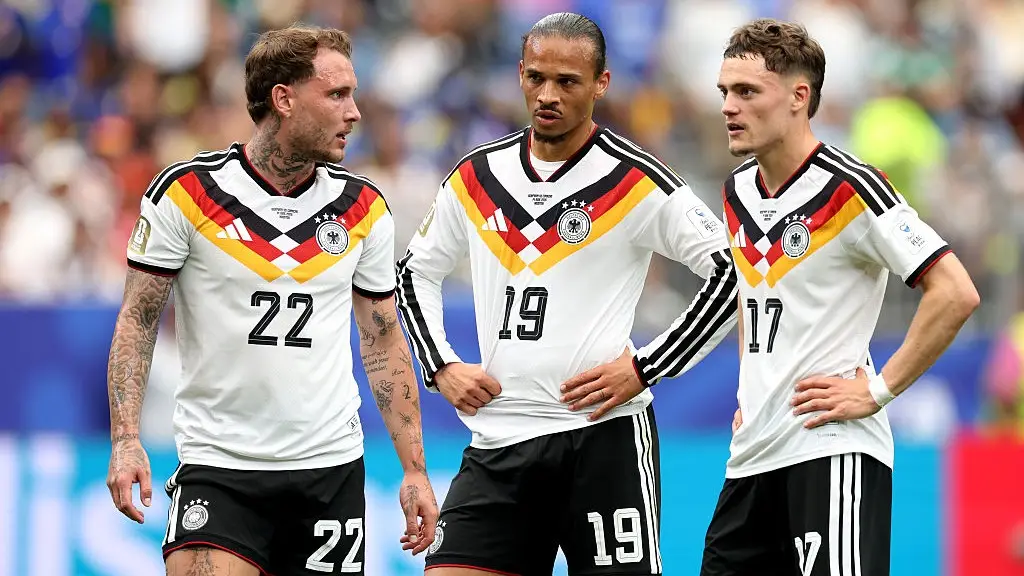
Why Germany play in white at World Cup despite it not being colour on their flag

With the 2026 FIFA World Cup in full swing, several questions about kits continue to be asked by supporters.
Throughout the tournament, which is currently taking place in the US, Mexico and Canada, supporters have noticed several subtle details on players' kits.
For example, three players – Harry Kane, Kylian Mbappé and James Rodríguez – have worn Golden Boot patches to mark the fact that they won the accolade at previous tournaments.
A similar patch is printed on the shirts of goalkeepers who have won the Golden Glove, with Argentina's Emi Martínez, Belgium's Thibaut Courtois and Germany's Manuel Neuer donning the patch during the current tournament.
Advert
READ NEXT: Little-known FIFA rule change could impact England after two countries benefit
Gold tournament logos are also worn by players whose nations have previously won the tournament – Argentina, Uruguay, Germany, Brazil, England, France and Spain.
All other nations wear black or white patches, depending on the colour of their kits.
Smaller patches can also be spotted below the tournament patch, with some players – such as Lamine Yamal and Erling Haaland - wearing debut patches to mark their maiden appearances at the World Cup.
Legacy patches have also been worn by Argentina's Lionel Messi, Portugal's Cristiano Ronaldo, Croatia's Luka Modrić, Germany’s Neuer and Japan's Yuto Nagatomo to mark the fact that they have appeared at five or more World Cups.
Meanwhile, World Cup-winning nations also wear stars to mark the achievement, with three-time winners Argentina donning three gold stars throughout the tournament.
African nations Egypt and Senegal usually wear stars as a nod to their achievements in the Africa Cup of Nations, but were asked to remove them by FIFA to avoid confusion before the World Cup.
Why do Germany wear white?
Even the colour of some nations' shirts has been under the microscope, with some fans asking why certain countries are wearing kits that bear no resemblance to their official flags.
One example is Germany, who traditionally wear a white home shirt with black, red and yellow trim.
The latter three colours make up the country's flag, but white, which is the predominant colour on the shirt, does not. However, there's an interesting explanation.
The reason Germany play in white is because it was the colour of the flag of Prussia – a historic German state that stretched from the border of modern-day Russia to France.
The state was the primary driving force behind the unification of Germany in 1871, but it was abolished in 1947 following World War II. Its former territories now form parts of several modern nations, including Germany, Poland, Russia and Lithuania.
Black and white also formed part of the colours of the German Reich, which, according to ESPN, “combined Prussia's black and white with the colours of the Hanseatic League, red and white, to arrive at black, white and red”.
When Germany’s national football team was first formed, it opted to wear the black and white colours of Prussia’s flag. Despite the Kingdom of Prussia being dissolved years later, the side decided to stick with those colours.
The flag also featured a black eagle, which is depicted on the country’s coat of arms and the national team's official emblem.
Germany return to World Cup action against the Ivory Coast on June 20, having beaten Curaçao 7-1 in their Group E opener.
Topics: Germany, FIFA World Cup
 Luke Davies