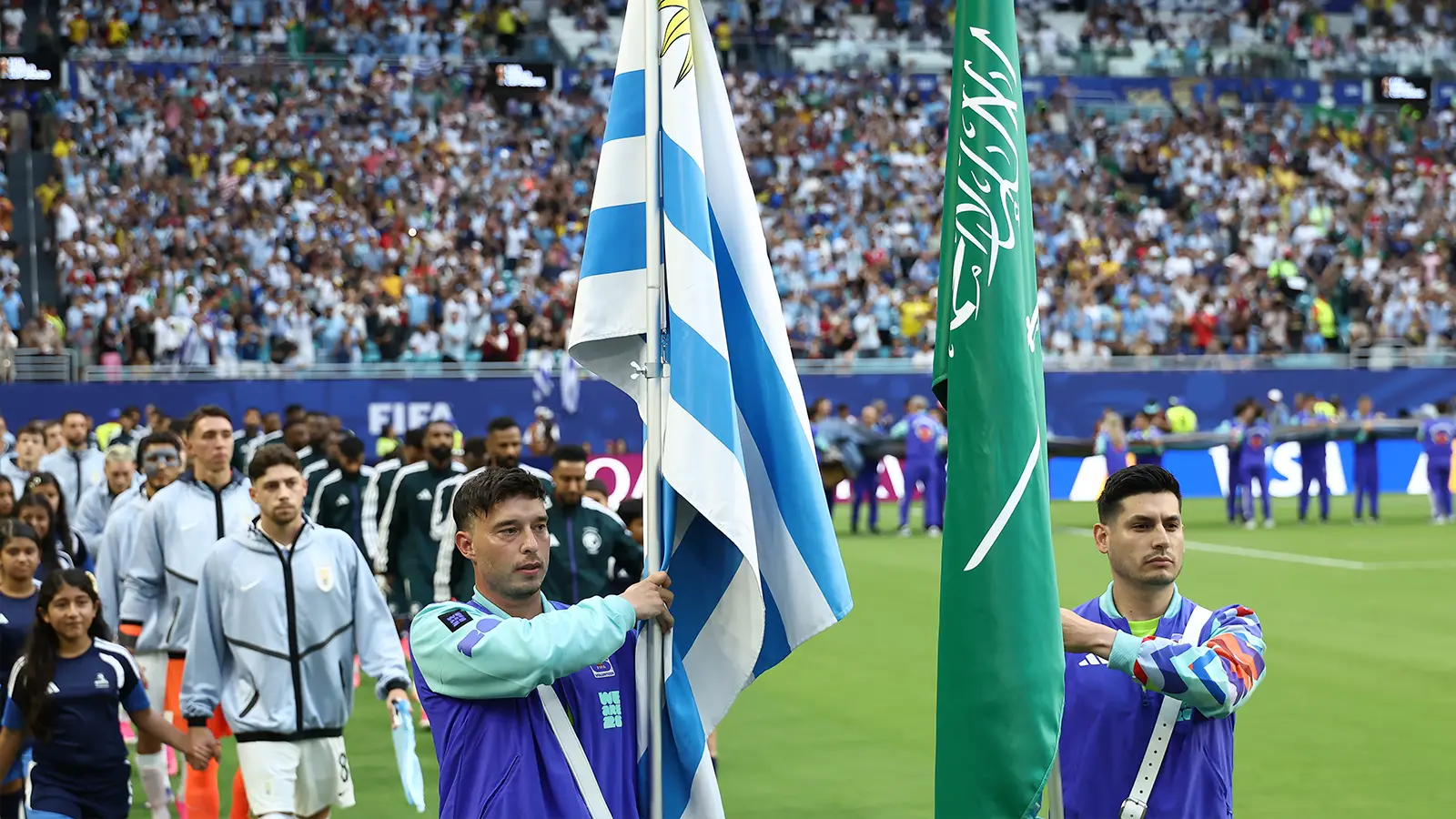
FIFA's pre-match ceremony changed for Saudi Arabia and Uruguay due to strict rules

FIFA's new pre-match ceremony was tweaked for one World Cup game because of strict rules involving Saudi Arabia and Uruguay.
The 2026 showpiece in North America, the first to feature 48 teams, has debuted a whole host of new practices - including hydration breaks, new laws administered by officials and the all-new pre-match set-up.
As seen in every game, entire squads have been gathering around the centre circle for the national anthem - with large flags of both countries unfurled on the pitch.
However, there was a striking difference for the 1-1 draw between Saudi Arabia and Uruguay.
Advert
While the anthem approach was the same, flags were raised by the bearers and held up instead of being left on the grass during the ceremony.
READ MORE: Iran player's World Cup tournament plunged into chaos as visa expires day after first game
Many users on social media noticed the change but there is a reason for why things were handled a little differently.
Saudi Arabia's green flag contains the Shahada - the declaration of faith in Islam.
The testimony reads, 'There is no God but Allah and Muhammad is the Messenger of Allah' and is considered sacred.
Because of this, the flag is typically handled with extra care and respect and that led to it being raised above the ground for the entirety of the ceremony.
With a need for balance, Uruguay's flag also received the same treatment.
For the same reason stated above, the flag is never flown at half-mast during mourning periods and cannot be displayed upside down.
In addition, commercial use is heavily restricted and there is often opposition to the flag being used on footballs.
Saudi Arabia vs Uruguay throws up controversy during World Cup game
Saudi Arabia and Uruguay played out a 1-1 draw at the Hard Rock Stadium in Miami, with Abdulelah Al-Amri's strike cancelled out by Maximiliano Araujo's equaliser in the 80th minute.
However, the game's finale was a controversial one as the referee blew up early in stoppage time.
Time was allowed to go beyond the allocated minutes with Uruguay on the attack but then when Saudi broke away, as the eighth minute of stoppage time approached, the official blew his final to signal full time.
However, the Saudi team also appeared to violate a new FIFA rule earlier in the fixture.
With around 60 minutes on the clock, goalkeeper Mohammed Al-Owais went down and received treatment.
While the referee checked on him, Saudi manager Yorgos Donis passed on tactical instructions to one of his players.
In doing so, Saudi broke a new rule brought in which banned tactical timeouts when goalkeepers go down with an injury - something which became a real issue in the Premier League.
Pierluigi Collina, Chairman for the FIFA Referees Committee, issued a warning prior to the tournament.
He told BBC Sport: "We held workshops with all 48 teams’ coaches, and we told them that referees would be proactive. They will not allow both teams to go to the bench when the goalkeeper is lying on the ground due to injury."
Despite the rule and tactical talks being banned in the aforementioned situations, referees cannot act and administer any type of disciplinary action.
Topics: FIFA World Cup
 Josh Lawless