England World Cup 2026 campaign simulated - with Thomas Tuchel controversial squad set for big shock

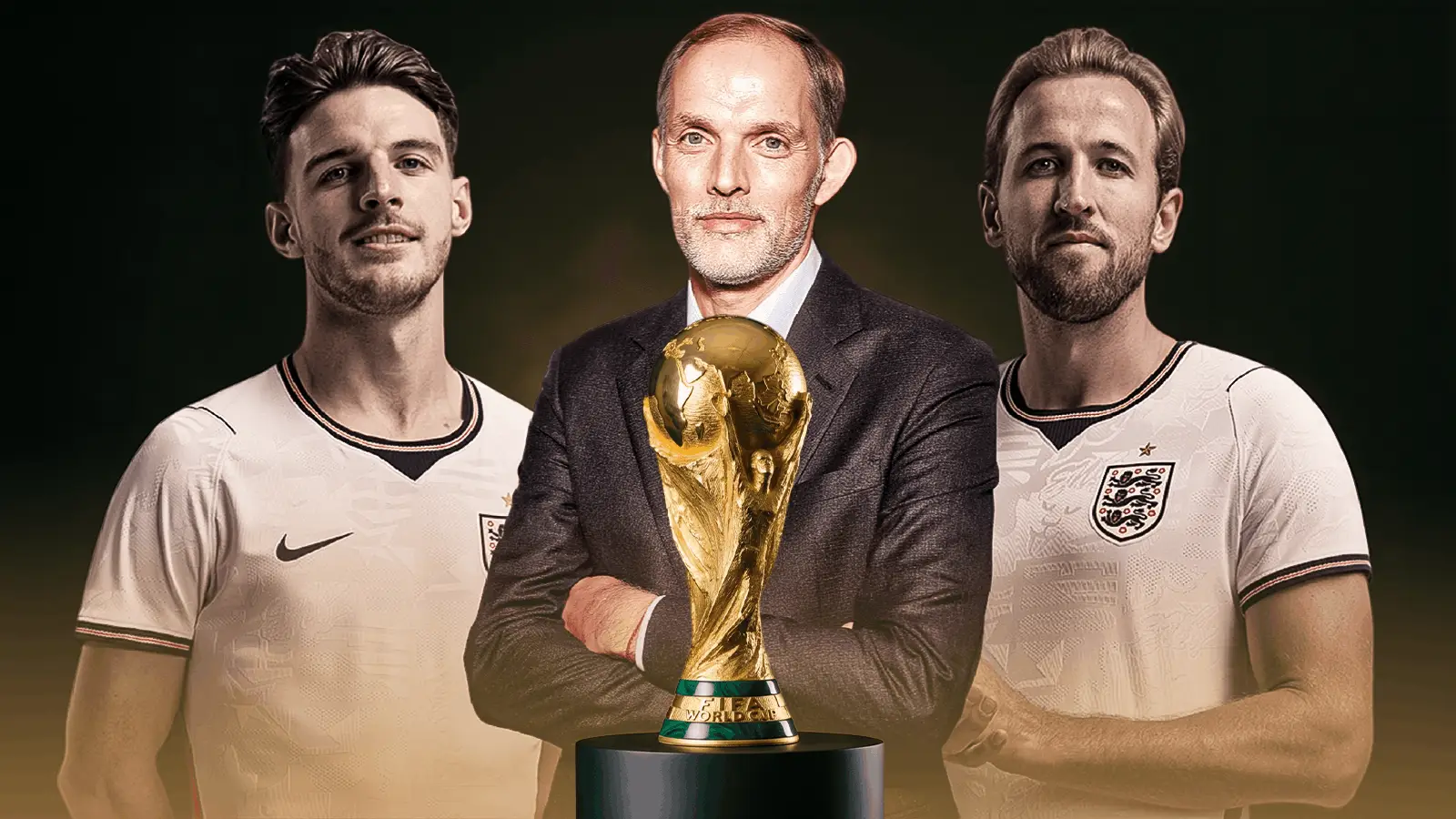
Thomas Tuchel has now named his final 26-man England squad for the 2026 World Cup - so we've put it through a simulation to see how the Three Lions get on.
The 2026 World Cup will be co-hosted by the United States, Canada and Mexico, though England play all three of their group games in the US.
They have been drawn in Group L and will take on Croatia, Ghana and Panama.
Tuchel made a number of controversial selections in his squad - as is the case for any major tournament squads - and chose to leave Harry Maguire, Trent Alexander-Arnold, Phil Foden, Adam Wharton and Cole Palmer at home.
Advert
Ivan Toney was included after ending the season as the top goalscorer in the Saudi Pro League, while Jordan Henderson and Dan Burn are also in after being praised by Tuchel for their impact on the dressing room and leadership capabilities.
READ NEXT: 'Secret' England player joining 26-man World Cup squad revealed after Thomas Tuchel was tight-lipped
Several England stars will be locked in to the first starting XI of the World Cup against Croatia, with Harry Kane, Declan Rice and Jordan Pickford among that group.
Bukayo Saka, Marc Guehi and Reece James will surely be in the side as well, while Morgan Rogers and Jude Bellingham will do battle to claim the attacking midfield spot.
We've put the entire 26-man England squad into Football Manager 2026 - which has introduced the return of international management in a new update earlier this week - to see just how far Tuchel and his players are expected to progress in the World Cup.
England progress through Group L - but it's not perfect
England will safely make it through the group stage of the 2026 World Cup, according to FM - but it isn't the absolute ideal set of results.
They are held 1-1 by Croatia in their opening game of the tournament, but bounce back by thrashing Ghana 5-0.
Panama are then comfortably defeated in the final group game - though perhaps not by the scoreline that Three Lions fans would hope, as England manage to win 2-0.

Tuchel lines up in a 4-3-3 formation, with a defensive midfielder and two more advanced midfielders behind captain Harry Kane.
Time for the knockouts
England's group win books them a spot against the Democratic Republic of Congo in the second round, with 32 teams making it through to the knockouts under FIFA's newly-expanded format.
DR Congo have plenty of threats in their side, including Lille centre-back Chancel Mbemba, Sunderland winger Noah Sadiki and Newcastle striker Yoane Wissa.
But the Three Lions prove to be too much, securing a 2-0 win to secure safe progression through to round three.
Next up is South American side Ecuador, who England defeated 1-0 under Sven-Goran Eriksson at the last 16 stage of the 2006 World Cup.
The same outcome is repeated 20 years later, with Thomas Tuchel's side winning 2-1.
That victory books England's spot in the quarter-finals, with a meeting against their second African opposition of the knockouts in Ivory Coast on the agenda.
Although Ivory Coast are three-time winners of the Africa Cup of Nations, they have never previously got out of the group stage at a World Cup across three attempts.
They missed out on the 2018 and 2022 editions altogether after failing to qualify.
But they are back in 2026 with a much more intimidating squad selection, with Wilfried Zaha, Amad Diallo, Ousmane Diomande and Franck Kessie among their key players.
And Ivory Coast manage to turn England's virtual World Cup into a nightmare, securing a 2-1 win.
England went ahead on 12 minutes through captain Kane, but their opponents equalised on 28 minutes through former Crystal Palace star Zaha.
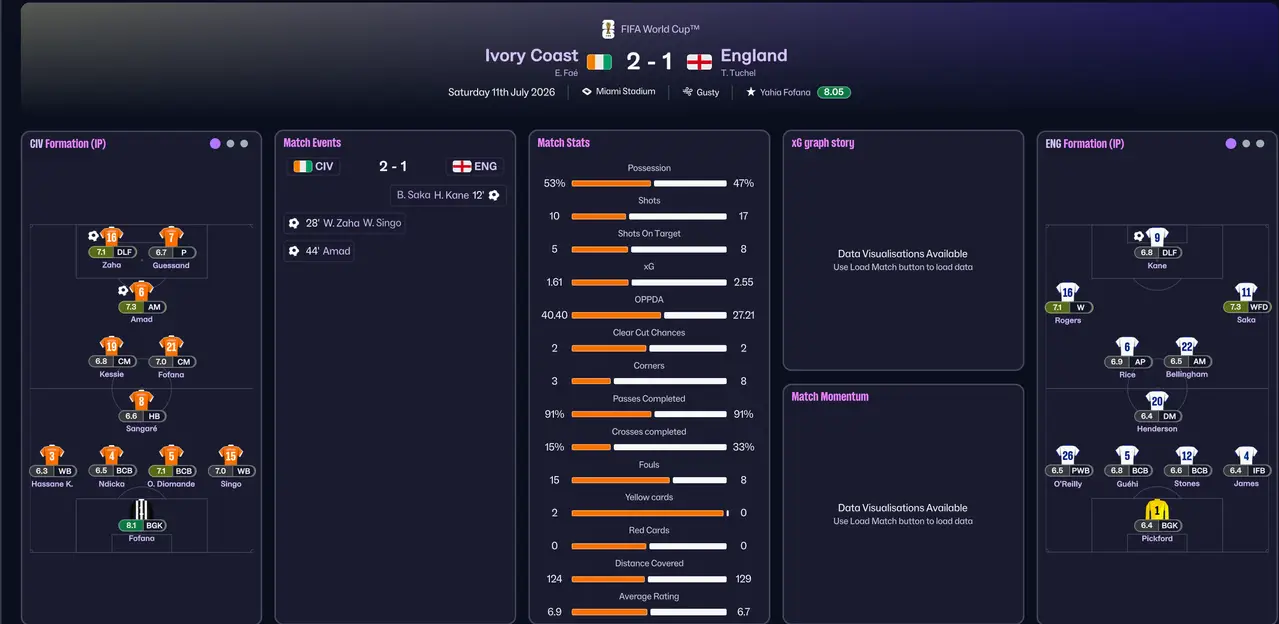
Manchester United's Amad Diallo then gave Ivory Coast the lead on 44 minutes - with England unable to respond as they suffered their third quarter-final exit in 20 years.
How Tuchel set up
Tuchel's formation was not too dissimilar setup to his real-life tactics, though he played with two advanced midfielders rather than a sole attacking midfielder in Rogers or Bellingham.
Instead, against Ivory Coast, he lined up with Jordan Henderson at the base of midfield instead of Declan Rice, with Rice forming part of the advanced midfield alongside Bellingham.
Rogers and Bukayo Saka played out wide behind sole striker Kane.
At the back, Jordan Pickford was in goal, while John Stones and Marc Guehi were Tuchel's preferred centre-back pairing.
Nico O'Reilly was chosen at left-back and was given licence to push forward, with Reece James slotting inside to form a back three when England had the ball.
The Three Lions had eight shots on target against Ivory Coast but only two of those were deemed to be clear-cut chances. Their opposition also slightly shaded ball possession numbers.
Who won the World Cup?
Despite Ivory Coast's heroics against England, they ultimately fell short of reaching a first-ever FIFA World Cup final.
Instead, Germany and France contested the showpiece event at the MetLife Stadium, New Jersey.
In a dramatic match, Ousmane Dembele equalised for France in the sixth minute of second half stoppage time after Liverpool's Florian Wirtz had put Julian Nagelsmann's side ahead.
Angelo Stiller made it 2-1 to Germany in extra time, before Dembele levelled for a second time in the match.
It was a 114th-minute penalty that decided the final, with captain Joshua Kimmich converting it for Germany to secure a 3-2 win and their fifth World Cup.
Topics: Football Manager, England, Thomas Tuchel, FIFA World Cup
 Ryan Smart