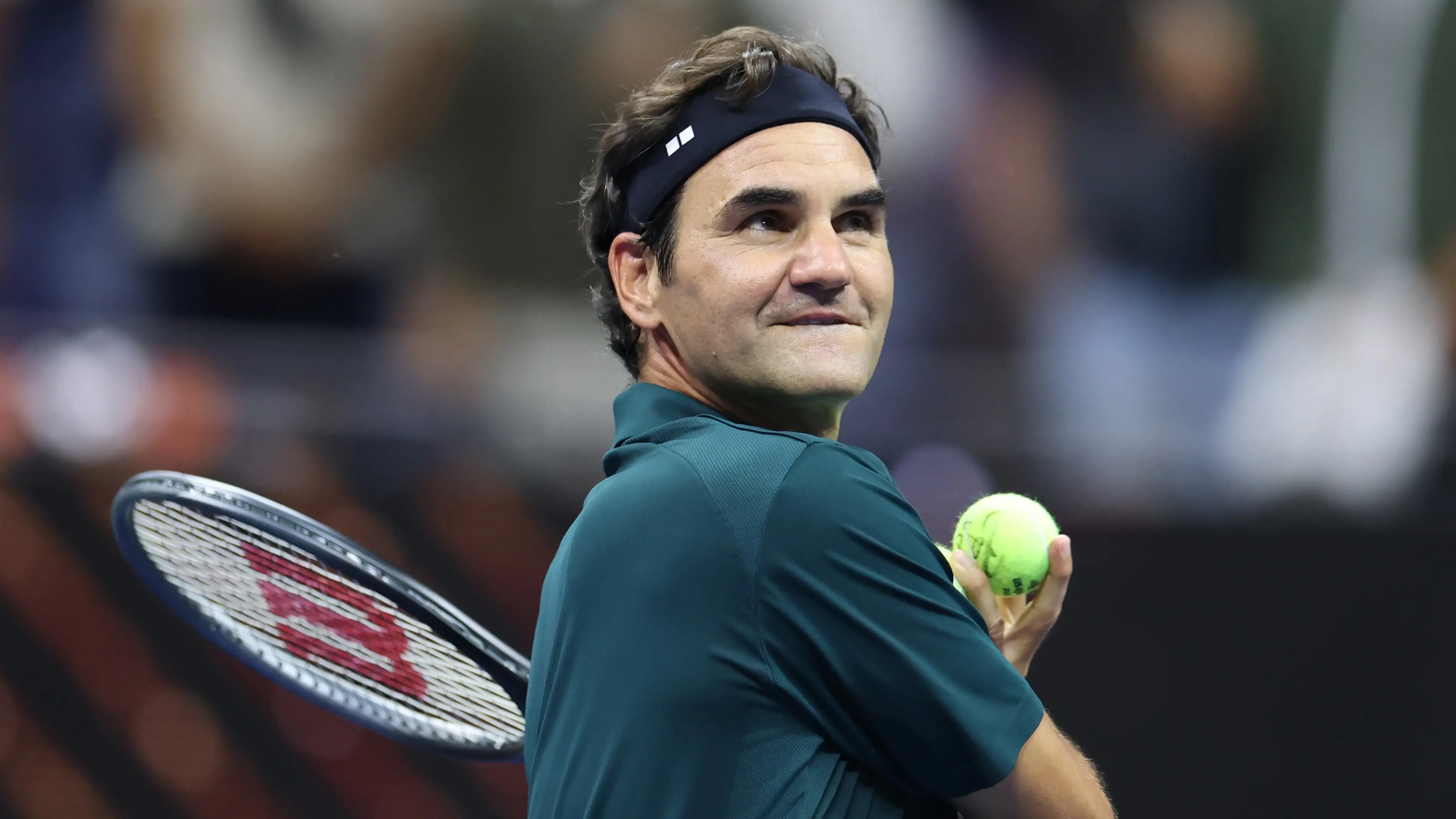
Roger Federer explains death of beloved tennis technique ahead of potential history at US Open

Roger Federer has explained the death of the one-handed backhand, which he himself possessed during his playing days, ahead of potential history being made at the US Open.
The 45-year-old fielded questions in a press conference upon his return to the US Open, where he played an exhibition match yesterday evening versus past rival Andy Roddick.
Federer and the American contested a selection of career-defining matches, including the 2009 Wimbledon final in which the Swiss prevailed 16-14 in the fifth set.
Roddick’s sole Grand Slam title arrived at the US Open in 2003, prior to Federer’s reign of dominance beginning. The American was widely perceived as the unlucky loser of an exceedingly close contest at Wimbledon in 2009 and was never able to win the tournament, losing in three finals to the now 45-year-old.
Advert
Federer won his sixth Wimbledon that afternoon, putting himself just one title behind American Pete Sampras who secured seven. The Swiss superstar won a record-equalling trophy in 2012 versus Andy Murray, then pulled ahead with a historic eighth Wimbledon win in 2017, where the then 35-year-old reached and won the final without dropping a single set en-route.
Federer ended his playing career with a remarkable 20 Grand Slam titles, 17 of which arrived between the years of 2003 and 2012. A further three were added from 2017-2018.
More remarkably, the Swiss superstar was able to win those later Slams still using a one-handed backhand, a beloved tennis technique, largely because of Federer, that is on the verge of being erased in the modern game. The 45-year-old provided his opinion on the issue, ahead of the US Open.
Federer discusses death of one-handed backhand ahead of potential history at US Open
The year’s final Slam could mark a disappointing moment in history for the one-handed backhand: Federer was told by reporter Gill Gross that if a one-handed backhander does not make it to the tournament’s semi-finals, it will be the first time in tennis history that it has failed to happen for an entire calendar year at Grand Slam events.
Federer winced at the question, physically and verbally, then offered his perspective on the technique, which he acknowledges is now far more difficult to be trained into rising talents.
“Good, tough question,” said Federer. “I love seeing one-handers do well… my coaches when I was growing up were 90% one-handers.
“When your coach is… you will be, too. Nowadays, the coaches are mostly double-handers — it’s easier to teach a kid to have two hands on the backhand side.
“One of my kids is switching from a double-hander to a one-hander, and I see how hard it is for him to hit it and control it. Eventually you get control, but it takes time. Nowadays, [players] don’t have time.
“And then you add racket technology, string technology, the slowness of the tennis balls and courts, and working less on transition, volleys… back in the day, I used to do 50-50 net play and baseline game.
“Before my time, it was 80% net play, 20% baseline, now it’s 90% baseline. The one-hander [used to be] an advantage, it seems that’s not naturally the case anymore.
“Double-handed is an easier shot to learn when you’re younger,” Federer confessed and concluded. “But I’m still hopeful it’s not the end,” he laughed.
Both of the now 45-year-old’s greatest rivals, Rafael Nadal and Novak Djokovic, are double-handed backhanders, with the latter in particular using that technique largely to his defensive benefit.
Federer bridged an era between the predominantly serve-and-volley, offensive play of the generation that preceded him, and the mostly baseline games of the great Slam victors that arrived after his prime.
The Swiss superstar, who won his exhibition match versus Roddick 6-3 yesterday evening, trained with one-handed backhander Lorenzo Musetti in a practice set the day prior to his win.
Musetti was the one-handed backhander that kept the streak of such players making it to a Grand Slam semi-final alive in 2025, when he made it to the final four of Roland Garros.
Federer also discussed the two worst losses of his career prior to his match versus Roddick. The now 45-year-old retired in September 2022, after a lengthy battle with injury in his late 30s to early 40s.
Topics: Roger Federer, Tennis, US Open
 Kedar Bayley