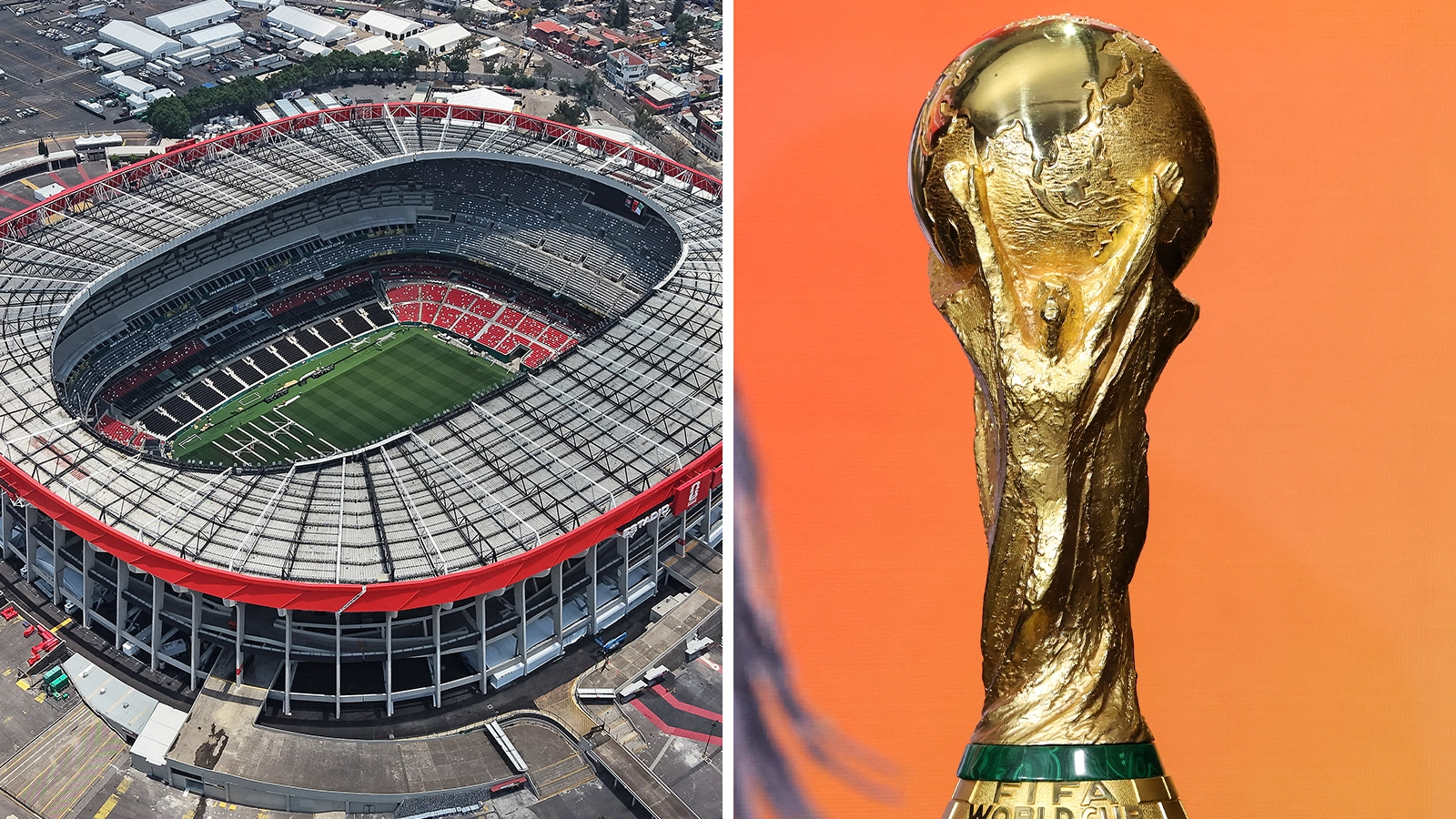
World Cup games played in Mexico will be slower than the United States and Canada as warning issued

World Cup matches in Mexico are poised to be slower than games in the United States and Canada, it has emerged.
Co-hosts Mexico are staging the opening fixture of the first ever 48-team tournament on Thursday 11 June when 'El Tri' take on South Afirca in a repeat of the 2010 opener.
Out of the 104 games at the World Cup, 13 will take place in Mexico across Mexico City, Guadalajara and Monterrey.
But it appears as though games in Mexico will be a little different to those in its neighbouring North American countries.
Advert
As highlighted in a TikTok by user @tiannahpedler, matches could be slower because of the altitude.
Mexico City is 2,240m above sea level and Guadalajara also has a similar elevation that is akin to ski resorts in Europe.
READ MORE: Mathematician who predicted last three World Cup winners names his 2026 pick
With more hard work required and recovery tougher, games at high altitude are naturally more physically challenging for players and is something that a high-intensity, pressing team will have to be aware of.
Francois Billaut, a professor at Universite Laval in Quebec, Canada with 20 years of research experience in the topic, told The Athletic that "barometric pressure" is lower at altitude and that "oxygen diminution becomes a major issue for endurance" as athletes' muscles receive less oxygen.
Back in 2023, Lionel Messi and Argentina players inhaled oxygen through tubes to prepare for a nightmare fixture above 3,637 metres above sea level at the Hernando Siles Stadium in La Paz, Bolivia.
Those same conditions were slammed as "inhumane" by Neymar and one point FIFA banned the stadium from hosting World Cup qualifiers due to its conditions.
Those playing in the high altitude will of course be well aware and no doubt adapted their preparation so that they can acclimatise.
However, on top of that, the ball and its flight is also impacted in stadiums at high altitude with thinner air as it can move faster and travel further.
That can bring about potential changes to ball trajectory with long passes, shots from distance and set-pieces - something goalkeepers must bear in mind.
World Cup conditions warning released by UNFCCC days before tournament
Mexico has the higher elevation but the conditions in all three countries are expected to be a key talking point throughout the World Cup.
The United Nations Climate Change released a detailed information pack on how big an impact the extreme heat will have on the action.
Cooling and hydration breaks will be a feature of the tournament as new data from World Weather Attribution has found that 26 of the 104 matches will take place in conditions where experts have advised FIFPRO, the global players union, that the hazardous heat "becomes a real risk".
Even Toronto and Vancouver, two of the cooler locations, are prone to a heatwave.
The findings also uncovered that nearly half of World Cup games have at least a 50% likelihood of "experiencing performance-impairing heat".
A study of 57 matches and 1,070 player observations from the Club World Cup found that players were exposed to extreme heat-illness risk in 31 games.
Many substitutes stayed inside the dressing room as games went on.
There is the feeling that subs and squad rotation will be extremely important during the World Cup because of the higher temperatures, with an expectation that some of the games may be less cautious as energy is conserved.
Topics: FIFA World Cup
 Josh Lawless