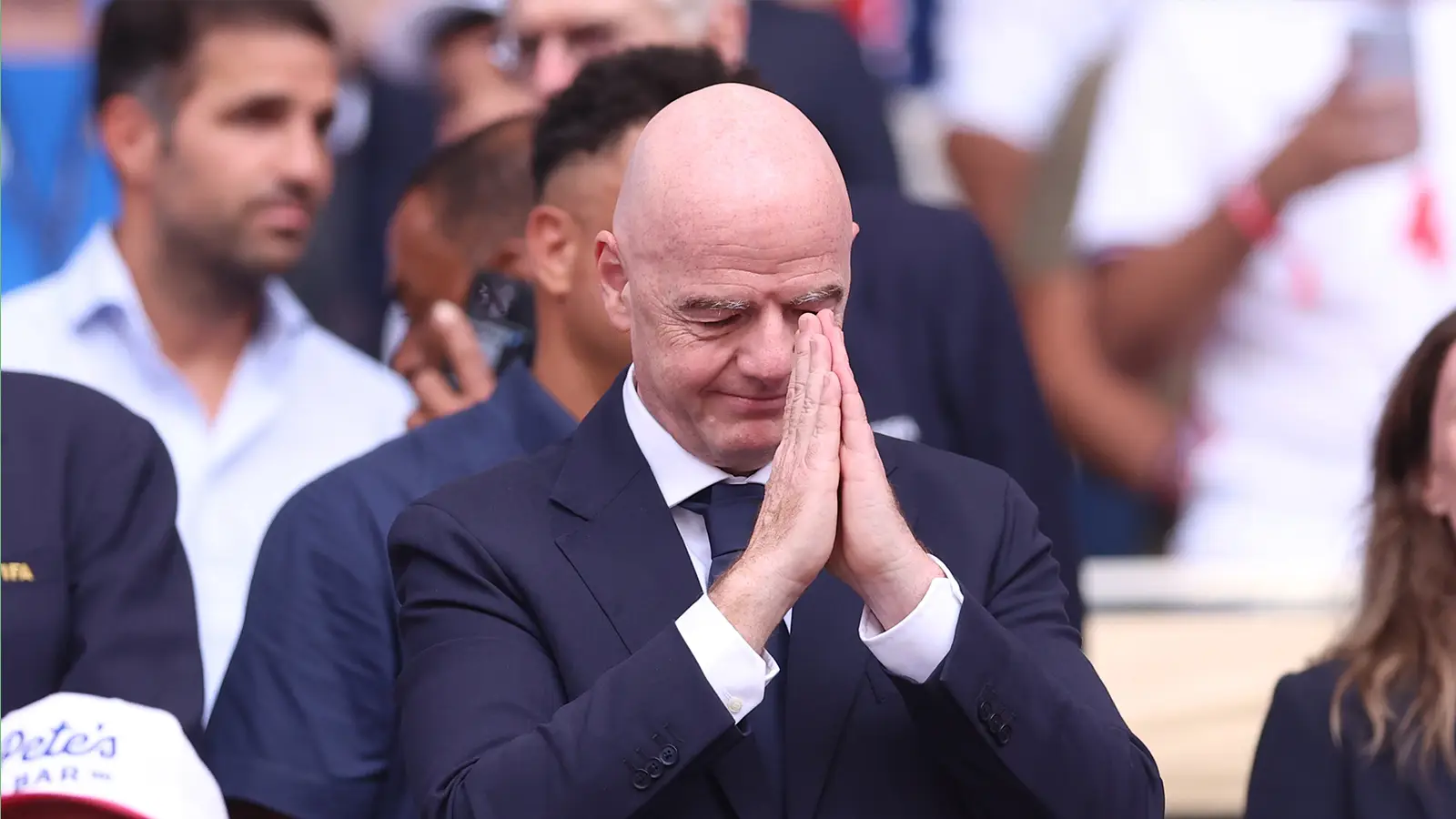
'We have not received a response' - FIFA silent over VAR audio request for World Cup's most controversial moment

FIFA have not acted on an official request to provide the VAR audio for the most controversial moment in the 2026 World Cup, it has been claimed.
The standard of refereeing in the tournament has been widely criticised, with the Egyptian FA releasing a furious statement after feeling wronged by decisions made in their 3-2 loss to Argentina.
Unhappy with one of their goals being disallowed following VAR intervention, they went as far as demanding "the exclusion of the referee and the entire crew from the World Cup after investigating these mistakes".
Officials from the federation bemoaned what they claim were "blatant errors and insisting on not reviewing some of the footage", leading to an official response from FIFA through FIFA Chief Refereeing Officer Pierluigi Collina.
Advert
However, Egypt were the only nation who felt extremely hard done by in the elimination from the tournament. Croatia were beaten by Portugal in the round of 32, with Goncalo Ramos scoring a 94th-minute winner.
Croatia thought they had equalised in the 103rd minute to force extra time when Josko Gvardiol poked home.
But the goal was chalked off following a lengthy VAR review which said that sensors in the Adidas Trionda ball had detected the slightest of touches from striker Igor Matanovic.
Matanovic looked like he had missed his header when the cross was swung in from the left, which would have made Mario Pasalic onside in the build-up.
Because the sensors detected a touch that Matanovic himself described as "slight contact with my hair", Pasalic was therefore offside, and so the goal was disallowed.
READ MORE: FIFA issue statement after Croatia's 103rd minute equaliser ruled out by VAR
In an explanation given by FIFA, the governing body said: "According to the data provided by Connected Ball Technology housed within the Adidas ball Trionda, the official match ball of the FIFA World Cup, it was proven that contact was made by Croatia's Igor Matanovic in the build up to the goal against Portugal, allowing the referee to correctly determine offside and disallow the goal.
"IMU sensors housed within the Trionda ball are capable of determining any slight contact, displayed to viewers in the broadcast as a 'heartbeat graphic', and allowing officials an unprecedented level of data to make fast, accurate decisions."
Croatia chief slams FIFA as he reveals request has not been made
More than a week on and Croatia are still not over the controversy.
Stipe Pletikosa, technical director of the Croatian Football Federation, offered strong thoughts on the state of the game and revealed that Marijan Kustic, president of the HNS, is yet to receive a response after requesting the VAR communications for the disallowed goal be revealed.
The organisation had previously argued that VAR protocol was not followed for the penalty call which went against them and that there was a misuse of the sensors concerning the Gvardiol disallowed goal.
Speaking to RTL, he explained: "We have thrown away the feeling of inferiority when we play against big teams and I hope we will no longer be in a situation where our placement is decided by other things than ourselves.
"We took an official position and immediately the day after the incident in the match with Portugal, President Kustić sent a harsh letter to FIFA, requesting insight into the VAR communication regarding that infamous chip. We have not received a response to this day,
"FIFA has stopped protecting football for the first time. It has had better and darker periods, but it has always protected the game. I'm not talking about referees, they will always make mistakes, it's a normal and integral part of the game.
"But the hydration break, the chips, the 18 minutes of half-time in the Croatia-England game... it has gone so far that the game is no longer protected. I am surprised that the people who work there, who should recognize situations and protect the game, do not react at all."
SPORTbible has approached FIFA for comment.
Following on from the disappointment, Zlatko Dalic left his position after leading the national team to the final in 2018 and a third-place finish four years later.
He has been replaced by former manager Slaven Bilic, who returns for a second spell.
The former West Ham player and manager was in charge for six years between 2006 and 2012.
Topics: FIFA World Cup
 Josh Lawless