FIFA issue statement after claims World Cup is 'rigged' for Argentina

FIFA have issued a statement after "unfounded" claims made regarding Argentina's round of 16 win over Egypt.
The reigning world champions came from 2-0 down to win 3-2 in Atlanta after a late-show featuring goals from Cristian Romero, Lionel Messi and Enzo Fernandez.
But the win was shrouded in controversy and led to mass uproar from the Egypt bench over a number of key decisions which didn't go their way.
The Egyptian FA released a furious statement calling for FIFA to remove the officials involved in the fixture as the federation "demanded the exclusion of the referee and the entire crew from the World Cup after investigating these mistakes".
Advert
The statement claimed the referee and his fellow officials were guilty of "blatant errors and insisting on not reviewing some of the footage".
One incident saw Mostafa Ziko have a goal disallowed following a foul on Lisandro Martinez being highlighted at the other end, while Egypt felt their talisman Mo Salah was fouled by Julian Alvarez inside the penalty area in the build-up to Fernandez's 93rd minute winner.
The sequence of events led to many pushing the idea that there is a conspiracy for Argentina to win the World Cup for a fourth time.
READ MORE: Ian Wright perfectly sums up Argentina vs Egypt VAR controversy and even Roy Keane backed down
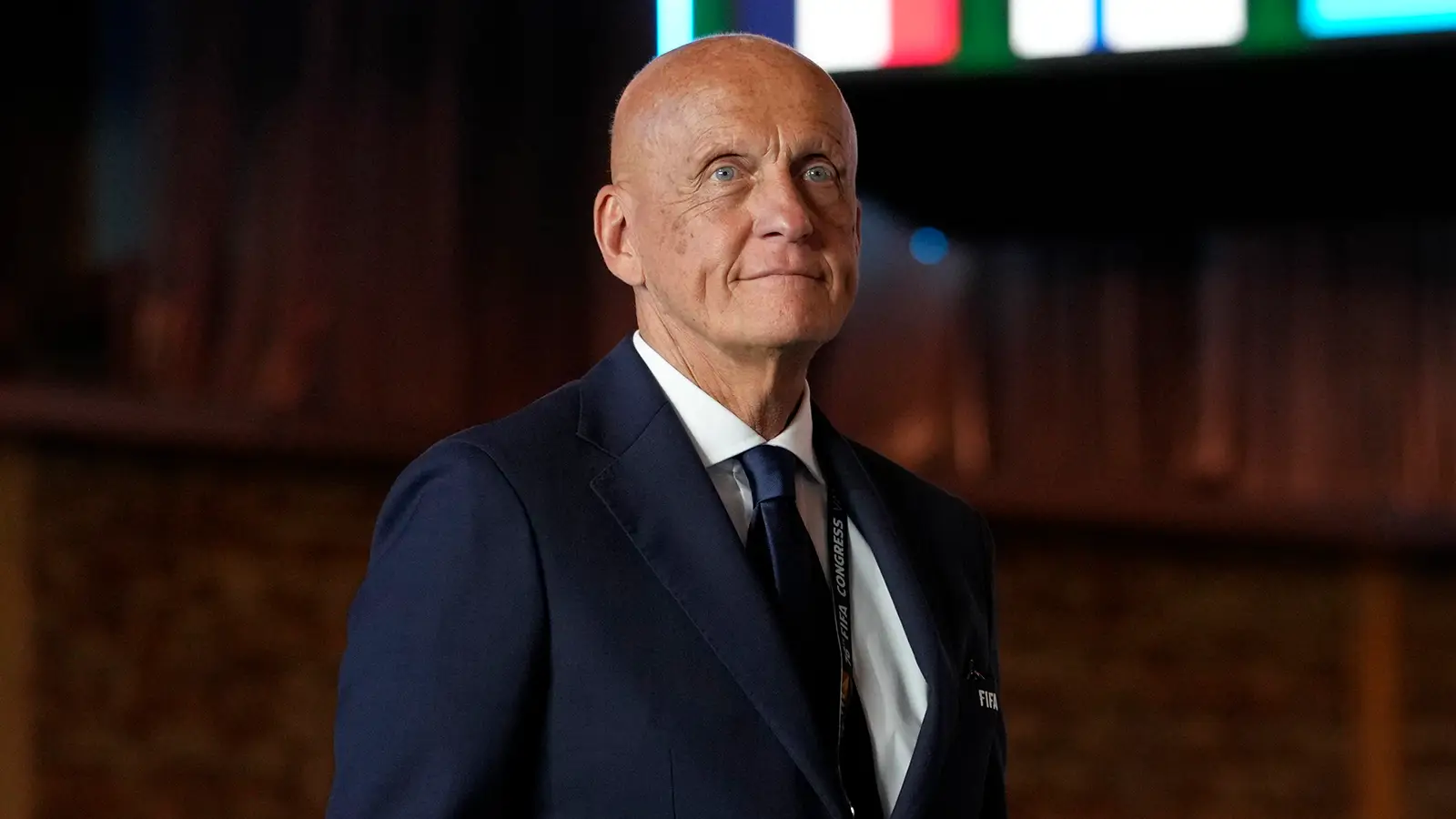
The claims prompted FIFA Chief Refereeing Officer Pierluigi Collina to release a statement where he slammed "unfounded allegations" and the questioning of match officials' integrity.
In an interview with the official FIFA website, the Italian said: "Of course, constructive discussion about decisions will always be part of football, but unfounded allegations have no place in our sport. Nobody can question the integrity of the FIFA World Cup match officials. When this happens, it may provoke reactions that lead to threats against them and their families. This is not right.
"Equally, nobody can claim that FIFA Refereeing can be influenced by anyone, not even by the FIFA President [Gianni Infantino]. He has always shown his full support for FIFA Team One while trusting us to work with complete independence. Match officials make honest decisions and, just like players and coaches, they always try to do their best."
Collina, who recently reviewed the introduction of new rules brought in for the World Cup, touched on the aforementioned incidents which infuriated Egypt and explained why the correct verdict was reached in both instances.
He continued: "After every goal is scored, the VAR checks the attacking possession phase (APP). If a foul is identified in the build-up and is deemed to have had an impact on the goal, the VAR will recommend an on-field review. There is no defined limit regarding either the distance from goal or the amount of time between the incident and the goal.
"An example of this came in the Argentina v Egypt game where Egypt No. 19 Marwan Attia clearly treads on the foot of Argentina No. 6 Lisandro Martínez.
"We believe that a foul is a foul. Regardless of whether the foul appears 'obvious', if the referee did not see it on the field of play, the VAR can intervene.
"Equally, if no foul is identified in the build-up to a goal, the VAR will advise the referee accordingly. Stepping on an opponent's foot is a foul, whereas a defender who touches the ball first and then makes normal football contact has not committed a foul. Again, an example of this came at the end of the same game. The referee and the VAR deemed it normal football contact between Egypt No. 10 Mohamed Salah and Argentina No. 10 Julián Alvarez.
"Of course, there will always be an element of subjectivity in some decisions, but we are happy with how this principle has been applied throughout the tournament."
Argentina take on Switzerland in the quarter final on Sunday, with the winner facing England or Norway in the semi-final on Wednesday 15 July.
Topics: FIFA, FIFA World Cup
 Josh Lawless