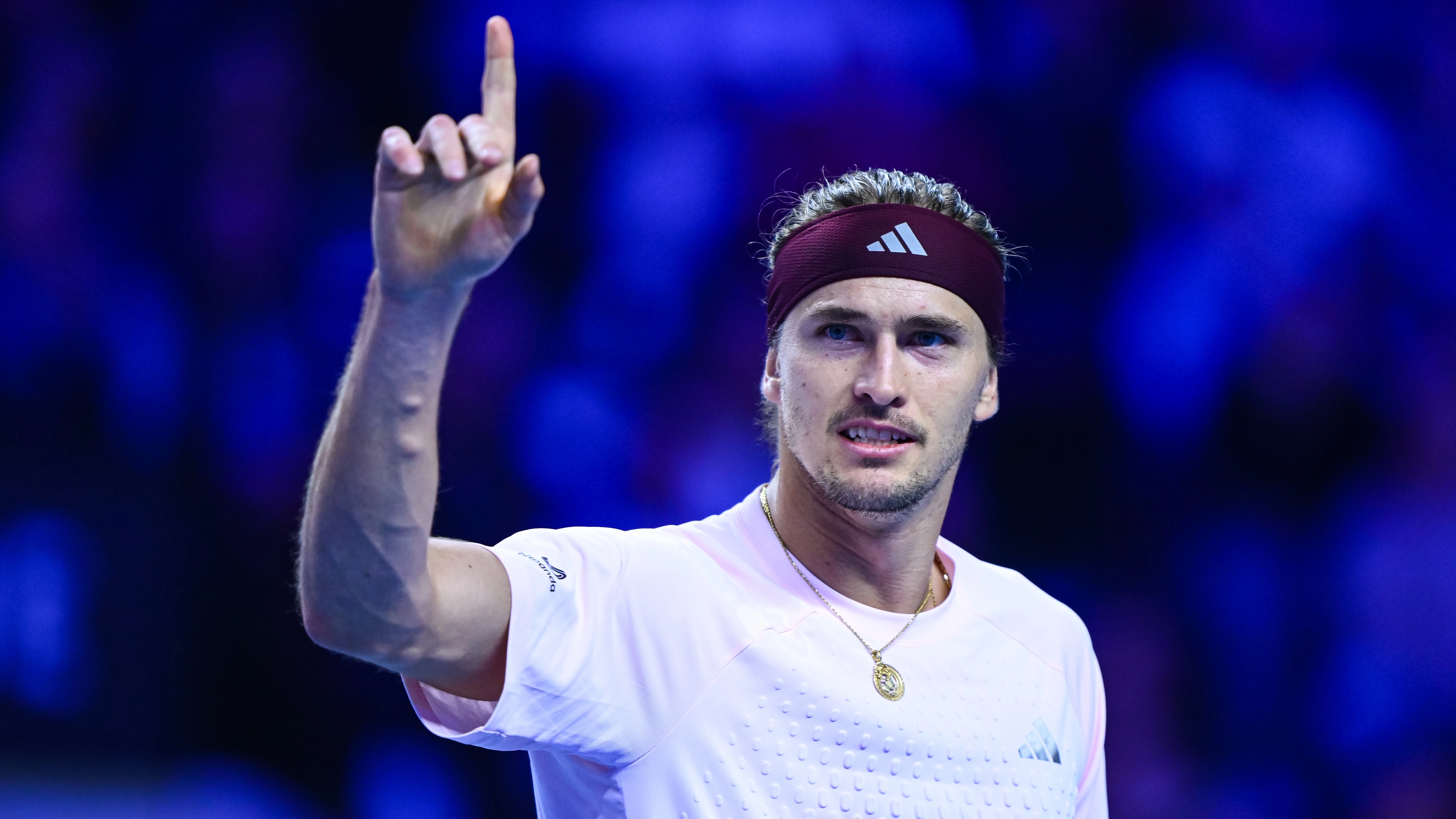
Journey to No1: Tracing Alexander Zverev's life-changing tennis season

Until recently, Alexander Zverev appeared destined to be tennis’s ultimate nearly-man.
Now, that’s all changed. His scintillating 2026 season, packed with big moments and unrivalled performance levels, has seen him become No1 at the earliest opportunity.
His 6-4 7-5 win tonight over Tallon Griekspoor in the Erste Bank Open’s round of 16 means he’ll secure the top ranking on Monday. It’s been an incredible season from the German - we analyse how he did it.
Alexander Zverev’s path to tennis immortality
Seen as one of the sport’s rising stars ten years ago, Alexander Zverev’s story looked like it might become a career unfulfilled.
Unable to reach the levels of tennis’s Big Three - Roger Federer, Rafael Nadal and Novak Djokovic - the German then found himself superseded by the emergence of Carlos Alcaraz and Jannik Sinner.
Advert
After losing his third Grand Slam at the Australian Open last year, it was widely thought by many pundits and fans that he might become the greatest player never to win one of the sport’s majors.
With early exits at Wimbledon and the US Open following, things began to appear bleak for a player fast approaching his 30s.
At the start of 2026, Zverev had a ranking of 5,110 points - closer to the 2,221st player in the world than the top two of Alcaraz and Jinner, who had 2,050 and 11,500 respectively.
Zverev: The semi-finals king
The German regrouped, only to find himself stopped again at the semi-finals stage of this year’s Australian Open by Alcaraz.
More semi-final defeats at the hands of Sinner then followed in Indian Wells and Miami in March, and then Monte Carlo in April (a run of events seen in the next bracket below the Grand Slams) meant the German was being handed more than his fair share of agony.
However, it was this string of tournaments that began to build his challenge for No1. While Alcaraz and Sinner were clearly top dogs, Zverev was the clear best-of-the-rest, racking up the ranking points.
When these two rivals became injured later on in 2026 - Alcaraz with a wrist issue in April, then Sinner’s knee issue following July’s Wimbledon - it was these points which would stand Zverev in good stead, a platform for his later triumphs.
Roland Garros royalty: How Zverev took his first Grand Slam
The 2026 French Open was the Grand Slam which changed the course of Zverev’s career.
With Alcaraz out, one half of the draw was already open to the German.
When Jannik Sinner then suffered a stunning loss in the searing Paris heat to Juan Manuel Cerundulo - having been one game away from winning his second-round match - it was suddenly all to play for.
Zverev was technically the best bet to win, but could he hold his nerve?
“I was ****ing my pants for two weeks straight,” he later told Andy Roddick’s Served podcast.
However, the 6ft 6in German stood tall and held his nerve, winning 6-1 4-6 6-4 6-7 (5-7) 6-1 against Italian Flavio Cobolli.
"We have been through injury, heartbreaks, losses. We have been losers at times in the most important moments," Zverev said.
"At the end of the day, we are Grand Slam champions now and that is what counts.”
He had shaken the monkey off his back and finally become a major winner, but there was even better to come.
Big in America: Zverev makes No1 challenge
Zverev would follow up his Roland Garros triumph with a best-ever run at Wimbledon, losing in the final 7–6 (9–7) 6–7 (2–7) 3–6 4–6 to Sinner. Many felt he played some of his finest tennis in this defeat.
However, a knee injury immediately after Wimbledon then took Sinner out for the remainder of 2026.
For the US Open, Alcaraz finally returned after four months away but, with the Spaniard still in recovery mode, it was Zverev who was now top dog.
His path through the tournament was the opposite of the French. In Paris, Cobolli was the only top 25 player he went up against the entire fortnight.
At Flushing Meadows, Zverev did things the hard way. His first two matches were both epic five-setters, finishing in the early hours - this meant the German would go to bed long after sun rise.
From there, he took on high-quality opposition such as Alejandro Tabilo, Luca Darderi and Botic van de Zandschulp, before facing ninth seed and home favourite Ben Shelton in the final.
On the decisive match point, Zverev was so focused on the play he didn’t realise he’d actually won the match - and his second Grand Slam. Such was the noise as the crowd erupted, he simply walked across the court to take the play, having to be told by his coaching team he’d won.
If one moment summed up Zverev’s approach to 2026, it was this. A player who was previously never quite focused enough, never quite up to standard, had complete tunnel vision in his attempt to win.
The final push to No1
Following the US Open, and with Sinner withdrawing for the rest of the year, it became apparent that Zverev had a shot at making it to No1.
After winning a brace of Davis Cup matches, he followed up a quarter-final exit to Djokovic in Shanghai with an ATP Masters 1000 semi in Beijing.
With no-one else playing with his level of consistency, it was just enough. When Alcaraz lost in Shanghai to Zizou Bergs, it meant Zverev was guaranteed to become No1 at some point.
The German did it at the earliest opportunity, his round of 16 win at Vienna’s Erste Bank Open meaning he’ll be No1 come November 2. He’ll have 9450 ranking points, the same as Sinner, but he’ll earn more as he progresses in his current tournament.
At 29, he becomes the second-oldest man to ever reach No1 status in tennis, having won 64 out of 80 matches this year, as well as Germany's second-ever male No1, after Boris Becker in 1991.
"It's been a wait but sometimes you have to wait for the best things in life," Zverev said.
"I'm super happy, super thrilled - I have no words for this year."
The Hamburg native did the unthinkable in 2026, overhauled a staggering rankings gap, and is now a multiple Grand Slam winner.
Topics: Tennis
 James Elson