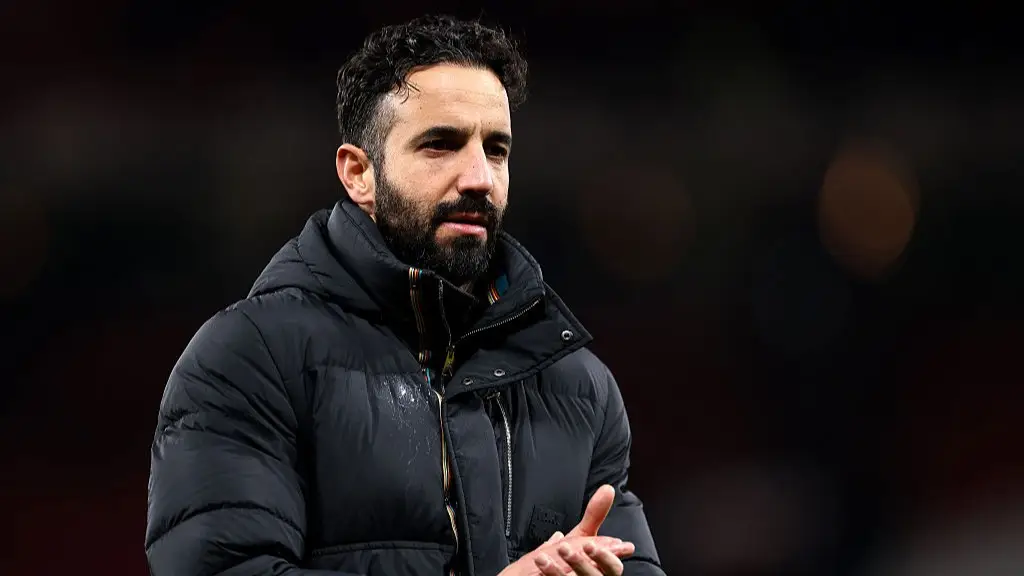
'He cornered himself' - Man Utd chief brutally sums up why Ruben Amorim failed at club

Manchester United chief executive Omar Berrada has outlined why he believes former head coach Ruben Amorim failed at the club.
Amorim arrived at United in November 2024 with a healthy reputation, having guided Portugal's Sporting CP to two Primeira Liga titles and two Taça da Liga titles.
However, he struggled to make a positive impact at Old Trafford as United finished a Premier League record-low 15th in the English top flight during the 2024/25 campaign, while also losing the Europa League final to Spurs.
Despite calls for his sacking, Amorim began the 2025/26 season as United boss but refused to move away from his preferred 3-4-3 (or 5-2-3) system.
Advert
Following a 1-1 draw against Leeds United at Elland Road in January, Amorim was sacked after 14 months in charge before being succeeded by Michael Carrick.
The Portuguese left United sixth in the league, but the club eventually finished third under Carrick and, in doing so, secured Champions League football.
Amorim has made no public comment since his United sacking, although he was appointed AC Milan head coach earlier in June.
Berrada speaks out on Amorim failure
While fans and pundits have already offered their thoughts on why Amorim failed at United, the club's hierarchy had remained quiet until last Saturday.
United CEO Berrada spoke about Amorim during an appearance at the FTWeekend Festival in New York.
Berrada explained how he believed Amorim struggled to cope with the pressure of managing United while being unable and unwilling to adapt his tactical philosophy, such as his favoured formation.
"I look back at the process of the appointment. I think the rationale for choosing him was sound," Berrada said. "He was a coach that had been very successful in Portugal with Sporting Lisbon.
"He was young, he was dynamic. He had a way of explaining his football knowledge and ideas that was very clear. We felt he was able to relate and communicate with the players and dressing room.
"Off the back of lots of changes of coaches in the last 10 years, we really wanted to give Ruben time to develop his ideas, his concepts and give him the freedom on the training pitch to be able to implement his ideas."
When pressed on the reason why the appointment did not go to plan, he added: "Again, Ruben, I think, has done many good things that contributed to the success we've had this past season.
"He helped raise the standard in the dressing room. He participated in the recruitment of the four players that we signed over the summer that had a very positive impact on the performance of the team.
"I think maybe where he got stuck is the size of the club — and a little bit on the reflection I made — the scrutiny of your ideas and decisions is so constant that perhaps he struggled managing that… Not that it was too big for him, but he maybe cornered himself in a position where he wanted to stick, in a very rigid manner, to his ideas because he wanted to show everybody that it's going to work.
"And in the context of the volatility of emotions you get by being part of Manchester United, when you lose two or three games in a row, then it's the end of the world. So I think that was very hard to manage."
Berrada was also keen to emphasise how Amorim came in "mid-season" without having a pre-season to get his ideas over to his players.
He added: "He didn't have time to implement his ideas. Then, by the time he got to the second season, he did have time to implement his ideas over the summer and we actually saw a really good start. We played really well in multiple games, but the weight of the previous season was still there.
"He perhaps wasn't able to move on at the right time, so we felt we had to make a change. And Michael Carrick came in in January and the team has turned it around."
Topics: Man Utd, Ruben Amorim, Premier League
 Luke Davies