The six Argentina players that could be banned for next World Cup as FIFA issue statement

Six Argentina players could be banned for the 2030 World Cup after FIFA confirmed disciplinary proceedings against them.
La Albiceleste failed to retain their crown after losing to extra time to Spain, who became world champions for the second time after Ferran Torres popped up with the winner.
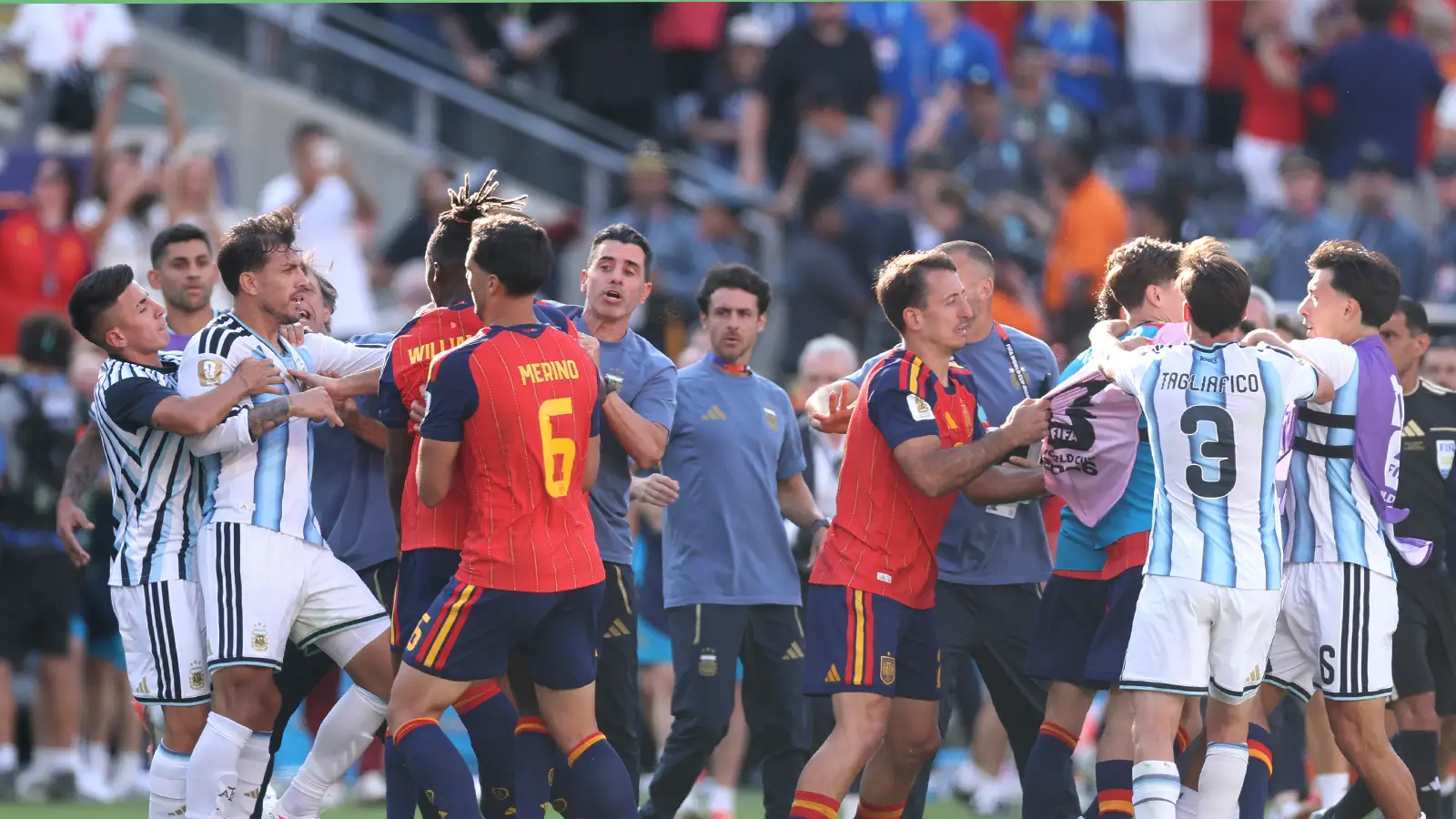
Chelsea midfielder Enzo Fernandez was sent off for two silly challenges but a number of Argentina players lost their heads at the final whistle and are now being investigated for their behaviour after the final whistle.
Nahuel Molina was caught on camera lashing out at Spain captain Rodri, while Leandro Paredes completely lost his head and went after both Eric Garcia and Gavi.
Advert
He was spotted grabbing Garcia by the throat and throwing Gavi to the floor, with FIFA's commentator information system incorrectly reporting that he was sent off.
Another shocking incident saw Argentina's assistant manager Roberto Ayala strike Dani Olmo in a fracas. Days later and he issued an apology for his actions, though was adamant it was "more of a push than anything else" and that "it wasn’t a punch.
Olmo did not accept the apology and accused Ayala of "lying' when he gave an interview to Spanish outlet Diari de Terrassa.
The aforementioned trio, as well as Thiago Almada and Spain's Gavi, were all referenced in a FIFA statement confirming disciplinary proceedings being taken for potential breaches.
The statement said: "The FIFA Disciplinary Committee has received the report of the appointed Disciplinary and Ethics Prosecutor concerning incidents that occurred during the FIFA World Cup 2026 final (Spain v. Argentina) and, following the recommendation contained therein, has opened disciplinary proceedings – for potential breaches of article 14 paragraph 1 i) of the FIFA Disciplinary Code (assault) – against Argentinian players Nahuel Molina (two counts, one completed and one attempted) and Leandro Paredes (three counts) and Argentinian official Roberto Ayala (one count).
“Disciplinary proceedings have also been opened – for potential breaches of article 14 paragraph 1 b) of the FIFA Disciplinary Code (unsporting behaviour) – against Argentinian players Nahuel Molina (one count) and Thiago Almada (one count) and Spanish player Pablo Martín Páez Gavira (one count).”
Separate proceedings were also opened into the displaying of a Falklands banner following on from the semi-final win over England.
The banner contained the words “Las Malvinas Son Argentinas”, which translates to "The Falkland Islands are Argentine", referencing the 1982 conflict.
There were a total of 907 deaths - 649 Argentine soldiers, 255 British combatants and three civilians as Argentina surrendered.
Since then Argentina have still repeatedly claimed sovereignty over the Falkland Islands and multiple players held up the political message after beating England in Atlanta.
Why could six Argentina players be banned for 2030 World Cup?
FIFA fined Argentina in 2014 when the full squad posed with the banner and disciplinary proceedings were opened over the latest message.
The statement said: "The FIFA Disciplinary Committee has opened proceedings against the Argentinian Football Association for potential breaches of article 13 paragraph 2 c) (Using a sports event for demonstrations of a non-sporting nature), article 14 paragraph 5 (Team misconduct), article 15 (Discrimination and racist abuse) and article 17 (Order and security at matches) of the FIFA Disciplinary Code in light of discriminatory chants and gestures, late kick-offs, failure to comply with match and security protocols, the display of inappropriate messages by the team and spectators and the throwing of objects by spectators in relation to several matches of the representative team of Argentina at the FIFA World Cup 2026.“
Cristian Romero, Lisandro Martinez and Giovani Lo Celso were the three players who were seen holding the banner, which appeared to be passed from the stands.
The Sun say that the trident, along with Molina, Almada and Paredes, could be hit with a ban that impacts the next World Cup.
While there is no confirmation of suspensions, it is worth noting that punishment of that kind would potentially apply to the 2030 showpiece.
Argentina are one of the co-hosts for the 100th anniversary tournament, hosting one game in Buenos Aires.
They do not need to qualify for the tournament and will not play in South American qualifiers - meaning the next FIFA fixture would likely be their opener in 2030.
Topics: Argentina, FIFA World Cup
 Josh Lawless