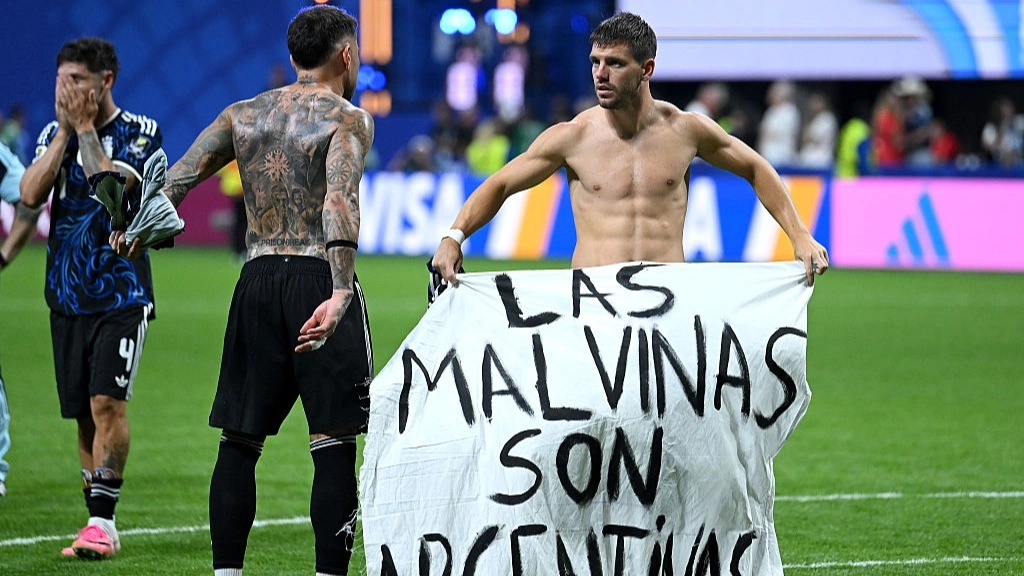
Argentina could exploit loophole to avoid FIFA sanction for Falklands flag display

Argentina will be hoping to avoid a FIFA sanction after displaying a flag emblazoned with the words “The Falkland Islands are Argentine” following their 2-1 World Cup semi-final victory over England.
Despite trailing for most of the second half against England, late strikes from Enzo Fernández and Lautaro Martínez ensured the world champions set up a mouthwatering final with reigning European champions Spain at MetLife Stadium in New York/New Jersey on July 19.
However, several Argentina players could be subject to a FIFA sanction after displaying a message reading "Las Malvinas son Argentinas", which translates as "The Falklands are Argentine".
The Falkland Islands, situated 300 miles off the coast of Argentina and 8,000 miles from the British Isles, were invaded by Argentina in 1982. After 10 weeks of conflict, British forces recaptured the islands, and Argentinian soldiers surrendered.
Advert
READ NEXT: FIFA may be forced to break protocol after concerning alert issued days before the World Cup final
A total of 655 Argentine and 255 British service personnel were killed, as well as three civilians. The Falklands are still the subject of a sovereignty dispute between the two nations.
After Argentina’s players displayed the controversial banner, Downing Street released a statement claiming: “The World Cup might not be ours, but the Falkland Islands definitely are”, before adding: “Our position is unchanged. Self-determination rests with the islanders.
“Our commitment to the Falklands will never waver.”
The spokesperson also claimed that Prime Minister Keir Starmer believes an investigation into Argentina’s conduct should be opened by FIFA.
On Thursday (July 16), a FIFA spokesperson said: "As is standard procedure, FIFA’s independent Disciplinary Committee is currently assessing the match reports and considering the relevant circumstances before deciding on potential further steps based on the FIFA Disciplinary Code.”
Article 34.3 of FIFA’s World Cup regulations states: “The display of political, religious or personal messages or slogans of any nature, in any language or form, by players and officials is prohibited at any time before the match, during the national anthems, during the match and after the conclusion of the match. The similar display of commercial messages and slogans of any nature, in any language or form, by players and officials is not allowed for the duration of their time at any official activity organised by FIFA (including official matches and training sessions, as well as during official press conferences and mixed-zone activities).”
Argentina were previously fined £20,000 by FIFA for holding a similar banner before a friendly against Slovenia in 2014.
FIFA decided the gesture had breached its rules on political gestures and team misconduct.
Since the banner was displayed, Argentina full-back Gonzalo Montiel claimed that it was thrown onto the pitch by a fan.
"They [fans] just threw one down from the stands, and the boys grabbed it,” he told Argentine media.
Argentine journalist Nelson Castro shared his view, adding: “Someone threw it onto the field, and they gave it to the players."
Whether the fact that the banner was thrown onto the pitch by a fan rather than a player or staff member may be seen as a mitigating factor, should the team be punished for their actions, remains unclear.
Falkland Islands government issues statement on World Cup controversy
The Falkland Islands government called for action from FIFA in the following statement: “The Falkland Islands Government is disappointed – though regrettably not surprised – that the Argentine football team decided to tarnish the result of last night’s World Cup football semi-final – a game that did not in any case involve the Falkland Islands.
“That said, it is hardly news to anyone that the people of the Islands were victims of an aggressive invasion in 1982, which left many traumatised. The banner displayed by Argentina last night, therefore, was particularly insensitive for many people in the Falklands.
“It is the avowed policy of the Falkland Islands government that we do not wish to see politics being brought into sport. Nor do we wish the Islands and their people to be used as a political football in every conversation about England and Argentina. We welcome the UK Government’s supportive statement this morning.
“As Business Secretary Peter Kyle highlighted, the World Cup has as one of its central tenets that politics is separate from football. We hope FIFA will make good on their promise to keep politics out of sport, and sanction all behaviour of this nature in line with its own rules.”
Topics: FIFA World Cup, Argentina, England
 Luke Davies