The incredible story of the first player ever to score a goal for England during his only cap

After the first-ever recognised international football match, between Scotland and England, finished goalless, it took just two minutes for England to open the scoring in their next encounter - and score the first-ever international goal in the process.
The two nations had played each other in five representative matches between 1870 and 1872, but none of them are officially recognised by FIFA.
Back then, the complex negotiations involved in setting up the first of those representative matches went as far as the FA chairman placing an advertisement in Scottish newspapers in Glasgow and Edinburgh; Scottish players based in London made up most of the visiting team.
By 1872, the entire Scotland XI was made up of players from Queen's Park, the dominant team in Scottish football at the time. Queen's Park had entered the previous season's FA Cup and took control of hosting the international match; the Scottish Football Association wouldn't be formed until 1873.
Advert
After the first goalless draw, then, so to the second match, held at London's Kennington Oval. Over 3,000 people are said to have attended the match - and it thankfully provided much more entertainment than the first one.
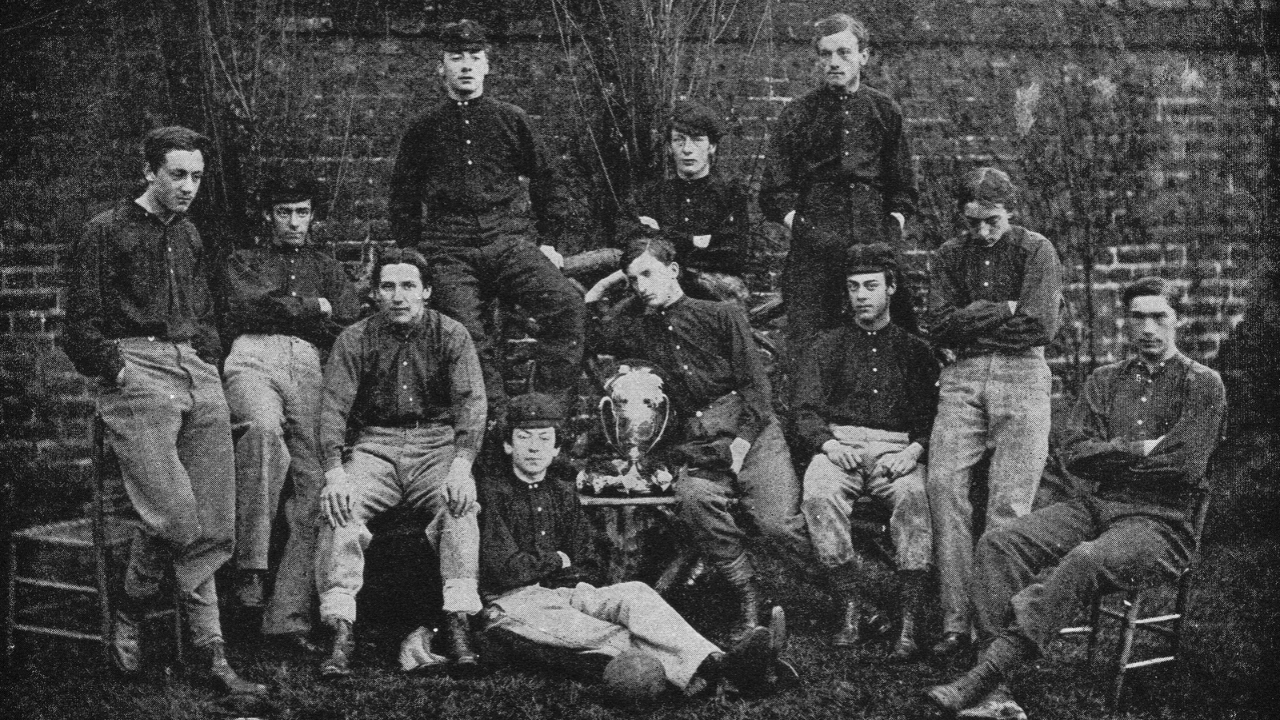
Forward William Kenyon-Slaney (pictured top right, without a hat, above), who played for English giants Wanderers, is credited with scoring the first-ever international goal, just two minutes into the contest. England went on to win 4-2, with Kenyon-Slaney scoring again in the second half.
William Kenyon-Slaney: England's first-ever goalscorer
Kenyon-Slaney was no ordinary footballer; professionalism in football wasn't legalised by the FA until 1885, so players had other jobs to prioritise.
The first-ever international goalscorer was in fact a lieutenant and captain without purchase, serving as part of the 3rd Battalion of the Grenadier Guards.
Kenyon-Slaney attended Eton College, and spent a total of 27 years in the army before retiring in 1892. He was born in 1847 in India, a country which was under the rule of the East India Company at the time and would remain so until the Indian Rebellion of 1858, before moving to England with his family.
He was also a keen cricketer, and is recorded as having played 11 first-class matches for Marylebone Cricket Club (MCC). Scorecards from that era are, as you would expect, relatively scarce, but there is record of Kenyon-Slaney having played for the MCC against Cambridge University in 1877 - where he was team-mates with the legendary cricketer of his time, W.G. Grace. He even top-scored during the MCC's first innings, albeit compiling only 16 not out in a total team score of 60 all out.
He was also a long-tenured politician, serving as Member of Parliament (MP) for Newport (Shropshire) between 1886 and 1908. He emerged victorious in five consecutive general elections while representing the Conservative Party.
Back to football, then, where Kenyon-Slaney never did play for England again after his brace against Scotland. He did, though, play in the 1873 FA Cup final, which his Wanderers side won by beating Oxford University 2-0.
In a sign of the times and in an unthinkable case when compared to the modern day, Oxford only made it through to the final because their semi-final opponents, the aforementioned Queens Park, could not travel down to London to play. And Oxford are recorded to have decided that, midway through the game, they would play without a goalkeeper after going 1-0 down. The plan clearly didn't work; they did win the FA Cup the following year, however, defeating Royal Engineers in the final.
Explaining why Kenyon-Slaney never played again for England, football historian Andy Mitchell told the BBC in 2023 that he 'almost certainly' committed himself to military duties first.
His great-grandson Rupert Kenyon-Slaney said: "It certainly wasn't appreciated during his lifetime, quite what that achievement [scoring for England first] was going to become.
"He certainly should be celebrated as the scorer of the first international goal, but beyond that you think you would struggling to describe him as a significant contributor to the game."
 Ryan Smart