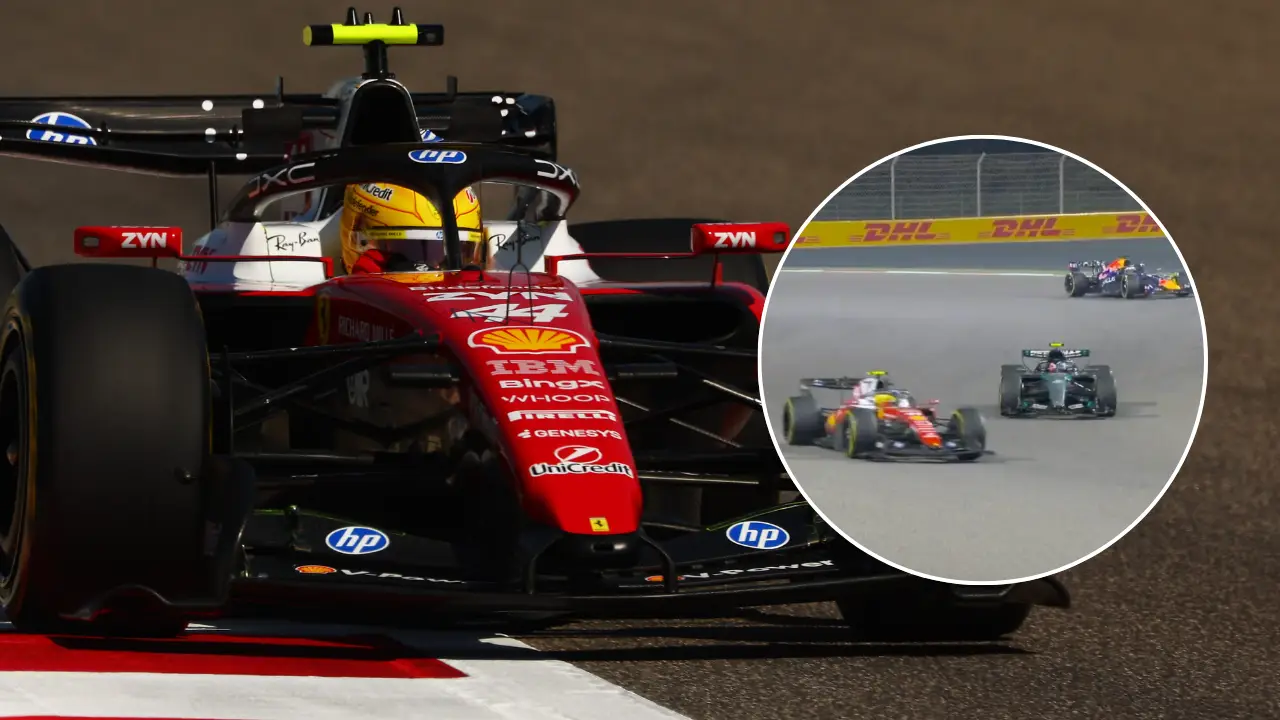
Lewis Hamilton leaves everyone stunned with what he did at end of F1 testing

Lewis Hamilton left viewers stunned after what he did at the end of day two of pre-season testing in Bahrain.
The seven-time world champion shared driving duties with Charles Leclerc in Sakhir on Wednesday, but was in the Ferrari for the entirety of the second day.
That gave him the opportunity to trial a radical new Ferrari innovation, which sees the upper section of the rear wing pivot 270 degrees when the brand-new active aerodynamics system is triggered by the driver.
It wasn't the ideal day for Hamilton or Ferrari, as his progress was halted in the morning by a chassis issue that restricted his running.
Advert
That meant the 41-year-old was only able to complete 78 laps over the day - with only Aston Martin, who have encountered major issues during testing, completing fewer (68).
Still, Hamilton's fastest time of a 1:34.408 was enough to place him in fourth, six tenths behind pacesetter Kimi Antonelli in the Mercedes.
But he instead raised eyebrows with what he managed to do after a late red flag fell on day two.
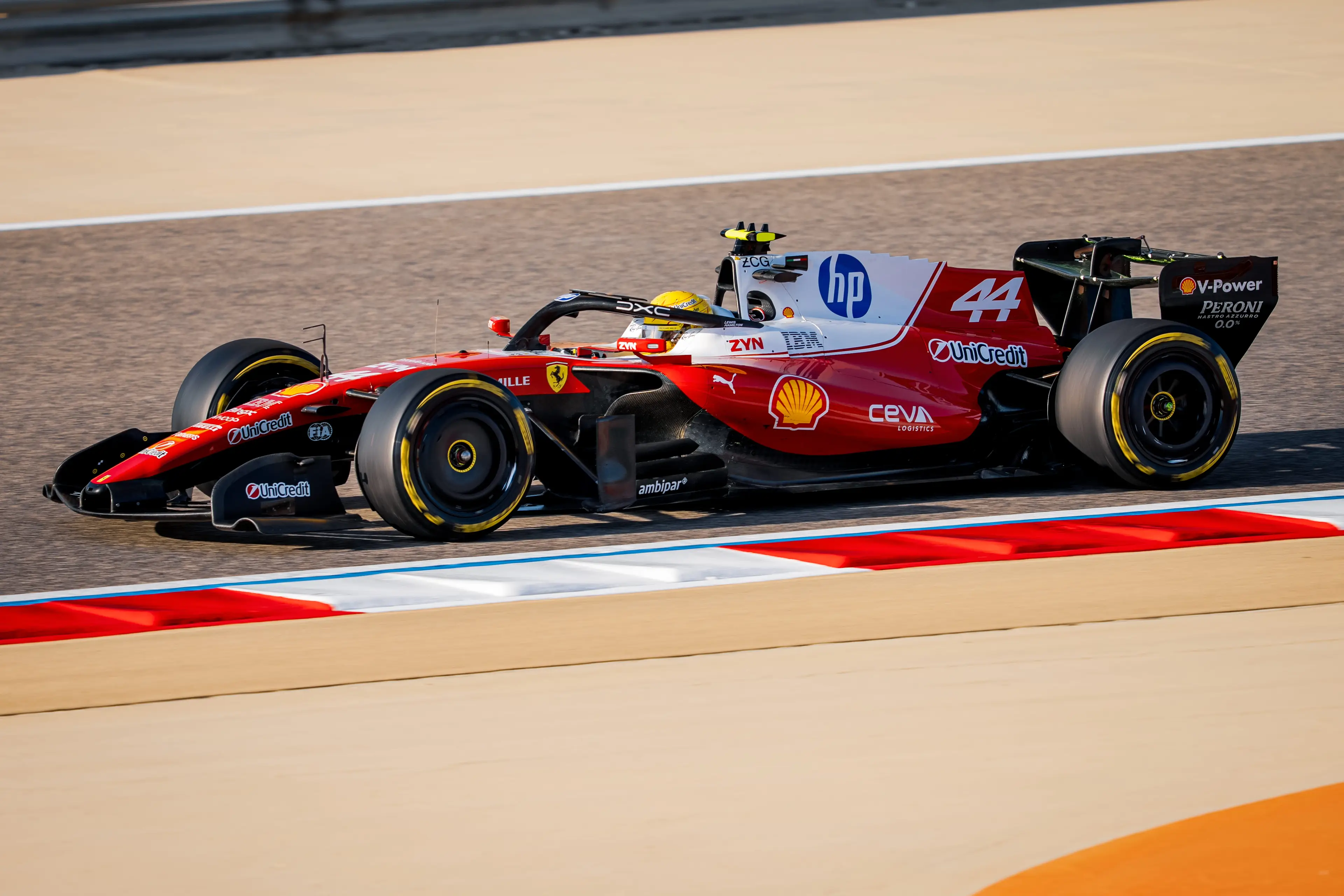
Throughout the week thus far in Bahrain, teams have briefly halted their programmes to take part in practice starts on the start/finish straight.
Concerns have been raised over the new race start procedure in 2026, given that teams have to rev their engines at the correct limit for around 10 seconds, while stationary, due to the design of the power units.
The FIA have stated that 'further evaluation of updates to race systems and on-car management' has been taking place during the third and final pre-season test in Bahrain.
As part of one of those evaluations, a red flag was waved with 10 minutes on the clock on day two, with each driver completing two formation laps.
Once they had lined up on the grid, the FIA trialled a new system whereby the grid panels flashed blue for five seconds before the start sequence begins.
The reasoning behind the system is to allow for a longer start procedure and give drivers more time to rev the turbochargers in their engine.
Hamilton lined his car up on the fifth row of the grid, with Max Verstappen, Kimi Antonelli, Ollie Bearman and Liam Lawson all ahead of him.
The seven-time world champion got off to a good launch, which was enough to draw alongside and overtake Lawson.
By the time all five cars got to turn one, Hamilton's start was such that he had pulled ahead of all three other drivers - including those that started up to four rows ahead of him.
He then got the best exit out of turn one and powered away from the field.
Of course, it must be stressed that there is no clear indication of whether each car was simulating an exact race start, or whether they were simply testing the revs needed.
But the short clip perhaps underlines both the concerns of various teams, and Ferrari's confidence, surrounding the race start procedures.
Speaking in a drivers' press conference on Thursday morning, Hamilton stressed his belief that the existing procedure is 'not dangerous' under the new 2026 regulations.
"It's definitely not dangerous," he told reporters.
"We should probably take that [dangerous] connotation away from it, because it's just a different procedure. It's just a longer procedure than it has been in the past.
"If, right now, you put the five lights up [to start], we would all still be standing there when the lights went out for a little bit longer. You can still pull away without the turbo going.
"You probably will anti-stall a couple of times. Perhaps the anti-stall is something that maybe is a potential for some people, but I don't think it's dangerous."
Topics: Ferrari, Formula 1, Lewis Hamilton, Max Verstappen
 Ryan Smart