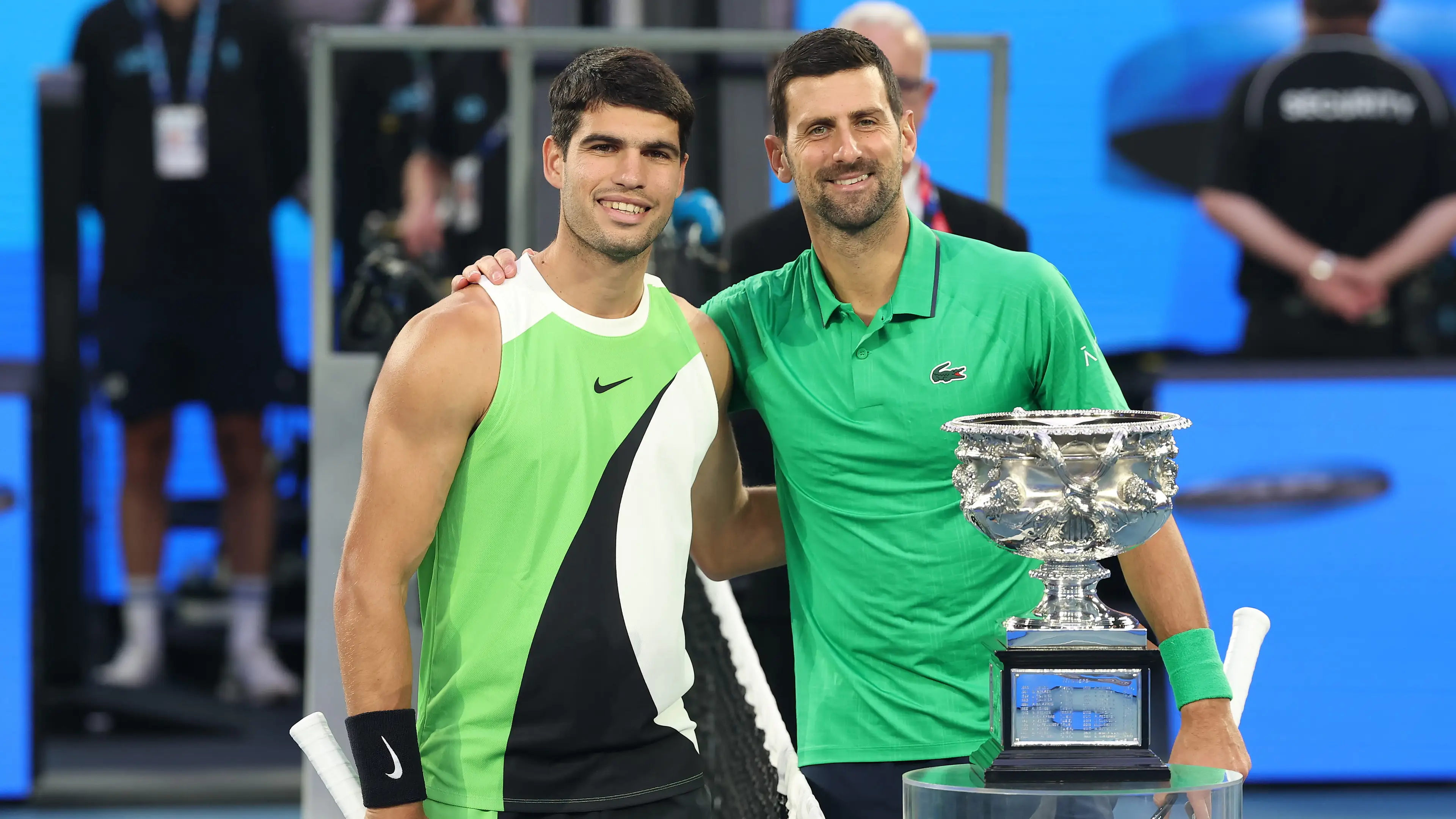
Carlos Alcaraz Instantly Loses Prize Money Following Australian Open Win

Carlos Alcaraz will instantly lose part of his prize money after his 3-1 win in sets over Novak Djokovic in the Australian Open men's singles final.
Alcaraz defeated Djokovic 2-6 6-2 6-3 7-5 in Melbourne on Sunday.
The win means that Alcaraz, who is ranked at world number one, has lifted the career Grand Slam - winning all four Slam events - at just 22 years of age.
He has become the youngest player ever to achieve the feat, beating the record set by compatriot Rafael Nadal, who was 24 years and 88 days old when he won the US Open title in 2010.
Advert
Djokovic, who defeated reigning champion Jannik Sinner in a semi-final epic, won the first set 6-2.
Alcaraz won by the reverse scoreline in set two, before appearing to complain to match officials over the roof being closed without consultation.
Winds of around 40mph were forecast for the final, with officials deciding that the conditions were too marginal for the roof to remain open.
The Spaniard then began to take control in set three, breaking Djokovic's serve to go 3-2 ahead, and then broke the Serb again to win it 6-4.
The final set was tighter, with Djokovic levelling at 5-5, but Alcaraz took the next two games to secure victory.
The winner of the Australian Open men's and women's singles titles each earns $4.15 million AUD - an increase of 19 per cent from 2025.
But Alcaraz will be forced to 'pay back' a certain amount of that prize money in tax.
The amount of tax required to be paid on tennis prize money depends solely on the location in which they are playing in, with different laws in place.
The tax laws are not administered by the ATP or WTA Tours, meaning that the money is instead paid to the local government that is hosting the particular event.
In the case of Australia, the estimated tax rate (as per MyTennisHQ) stands at around 32.5 per cent.
So, while not an exact amount, Alcaraz stands to lose around $1.349 million AUD of their total winnings through tax.
Most international players are classed, for tax purposes, as foreign residents, and are therefore only taxed on their income earned in Australia.
Australian outlet AFR reported that agents of the top 10-ranked men's and women's players had arranged a meeting prior to the tournament, in which they had held talks over 'seeking a bigger share of the Australian open revenue'.
Topics: Carlos Alcaraz, Novak Djokovic, Tennis, Australian Open
 Ryan Smart