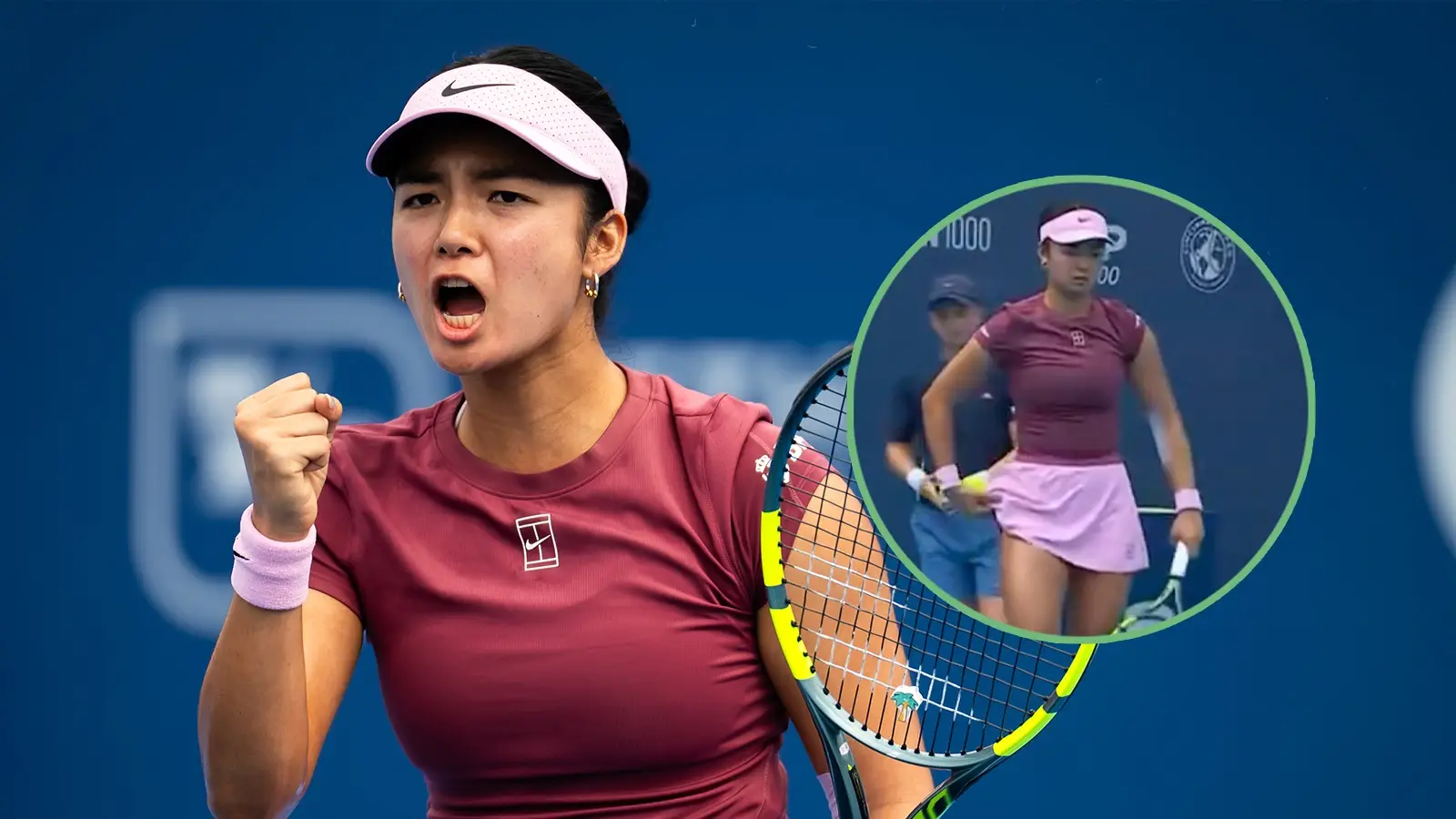
‘Might look easy...' - Commentator gives fascinating insight into Alex Eala's 'biggest weakness' at Cincinnati

Alex Eala’s serve was the subject of some fascinating analysis during her victory over Elena-Gabriela Ruse at the Cincinnati Open.
The 21-year-old was facing off against Ruse in the Round of 64 at the WTA 1000 event, and won the first set 6-1 before her opponent was forced to retire down 3-0 in the second.
The Filipina won nine out of the ten games played, in exactly one hour, and will move on to face world number 10 Amanda Anisimova in the next round in Cincinnati.
Eala landed 18 of her 34 first serve attempts for a 53% accuracy. That was offset by a stellar second serving performance: 16 out of 16 attempts landed.
Advert
Ruse’s serving performance was worse in both metrics: 11 out of 29 first serves (39%) and 15 out of 17 second serves (88%).
Eala won 67% of her first serve points, and 69% of her second serve points, to Ruse’s 45% and 18% in each category.
Despite failing to hold serve in her opening game, the match was a comprehensive victory for the Filipina, who won the next nine consecutive games. The clash was ended prematurely by an ankle injury to her opponent, who had called a medical time-out shortly before a lightning delay. Almost immediately after the restart, Ruse retired.
‘It might look easy but….’ - Commentator analyses Eala’s serve after Serena Williams’ former coach sees weakness
Rick Macci, the former coach of Serena Williams, described the 21-year-old’s serve earlier this week as an aspect of her game that had, he claimed, been “incorrectly taught” to her as a junior.
“Number one culprit on the WTA Tour, the leg drive does not initiate racquet entry at the proper time. If you do millions of anything, it will get better, but the timing will never be like Federer,” he wrote on social media.
“Any tip, suggestion, tweak or change is a band-aid. She is smooth, relaxed, and flowing but was taught incorrectly as a junior when growing [up],” Macci explained, as part of a comprehensive analysis on the biomechanics of Eala’s serve.
In yesterday’s face-off versus Ruse, a totally different, and much more positive, perspective was offered on commentary over the Filipina’s perhaps underrated weapon, emphasising the difficult spin she is able to put on the ball.
“That spin, especially on quicker hardcourts, or grasscourts, where Eala has traditionally played well, [her serve] just twirls and swirls around. Not easy to handle at all,” it was explained.
“It might look easy on the TV screen, but in real life, a lot of players don’t like to handle it.”
Immediately after saying this, Eala’s second serve, which appeared exceedingly slow but also in possession of an unusual spin, was returned directly into the net by Ruse.
The commentator then recalled the 21-year-old’s 6-4, 6-2 victory against multi-Slam winner Naomi Osaka in Washington last month, in which her serve played a crucial role.
“Naomi [Osaka] for the life of her… [she] couldn’t figure out where to stand on that second serve, she was trying [everywhere],” claimed the commentator.
In that match, Eala outperformed her opponent in all serving metrics: first and second serves landed, and first and second serve points won.
The Filipina athlete went on to win that WTA 500 event in Washington, the first Tour singles title of her career, beating Jessica Pegula in the final.
Eala will next play in Cincy tomorrow, as she looks to secure her first WTA 1000 title.
Topics: Tennis
 Kedar Bayley