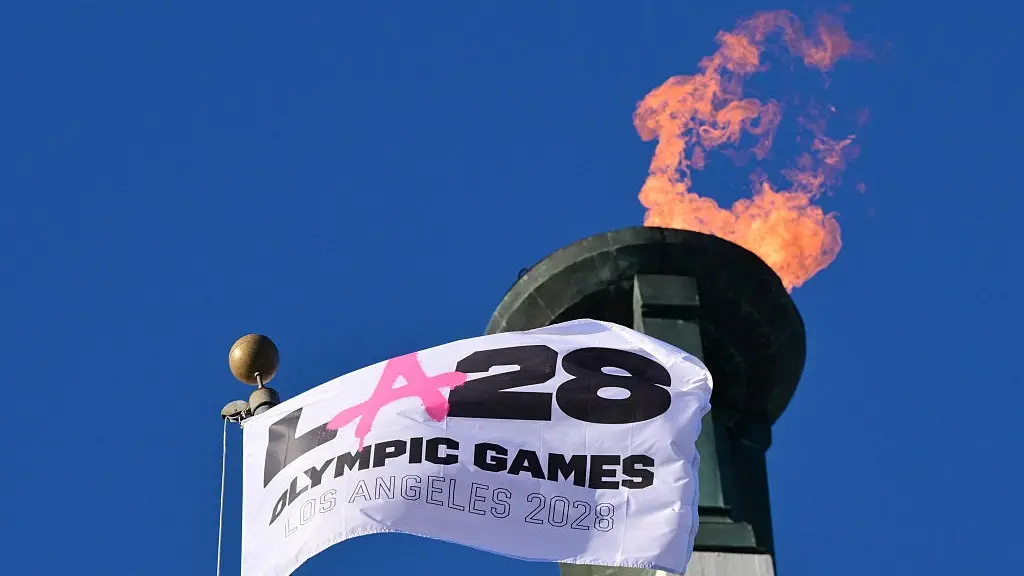
IOC make decision on banning trans athletes from LA 2028 Olympics

International Olympic Committee (IOC) president Kirsty Coventry has issued a statement after the body confirmed that women’s Olympic categories will be limited to biological females from the 2028 Games in Los Angeles.
On Thursday (26 March), the IOC confirmed that eligibility will be determined by a “once-in-a-lifetime” sex test.
The sex test would effectively prevent transgender women from competing in female categories.
The initial eligibility test will be based on an SRY gene test, which detects the presence or absence of the SRY gene. The SRY gene is part of the male Y chromosome and causes male characteristics to develop.
Advert
In a statement released on its website, the IOC said: “Based on scientific evidence, the IOC considers that the presence of the SRY gene is fixed throughout life and represents highly accurate evidence that an athlete has experienced male sex development. Furthermore, the IOC considers that SRY gene screening via saliva, cheek swab or blood sample is unintrusive compared to other possible methods.
“Athletes who test negative for the SRY gene permanently satisfy this policy’s eligibility criteria for competition in the female category. Unless there is reason to believe that a negative reading is in error, this will be a once-in-a-lifetime test.”
According to the body’s statement, it views the updated process as “evidence-based and expert-informed”, which in turn “protects fairness, safety and integrity in the female category”.
The IOC also added that the ruling “is not retroactive and does not apply to any grassroots or recreational sports programmes”.
IOC president Coventry explained that the policy has been announced based on information from “medical experts”.
“As a former athlete, I passionately believe in the rights of all Olympians to take part in fair competition," she said. "The policy that we have announced is based on science and has been led by medical experts. At the Olympic Games, even the smallest margins can be the difference between victory and defeat. So, it is absolutely clear that it would not be fair for biological males to compete in the female category. In addition, in some sports it would simply not be safe.”
Coventry continued: "Every athlete must be treated with dignity and respect, and athletes will need to be screened only once in their lifetime. There must be clear education around the process and counselling available, alongside expert medical advice.”
The IOC also made clear that an exception may be made for those "with a diagnosis of Complete Androgen Insensitivity Syndrome (CAIS) or other rare differences/disorders in sex development (DSDs) who do not benefit from the anabolic and/or performance-enhancing effects of testosterone".
Topics: Olympics
 Luke Davies