Norway manager reveals what referee told him about England goal that has caused so much controversy

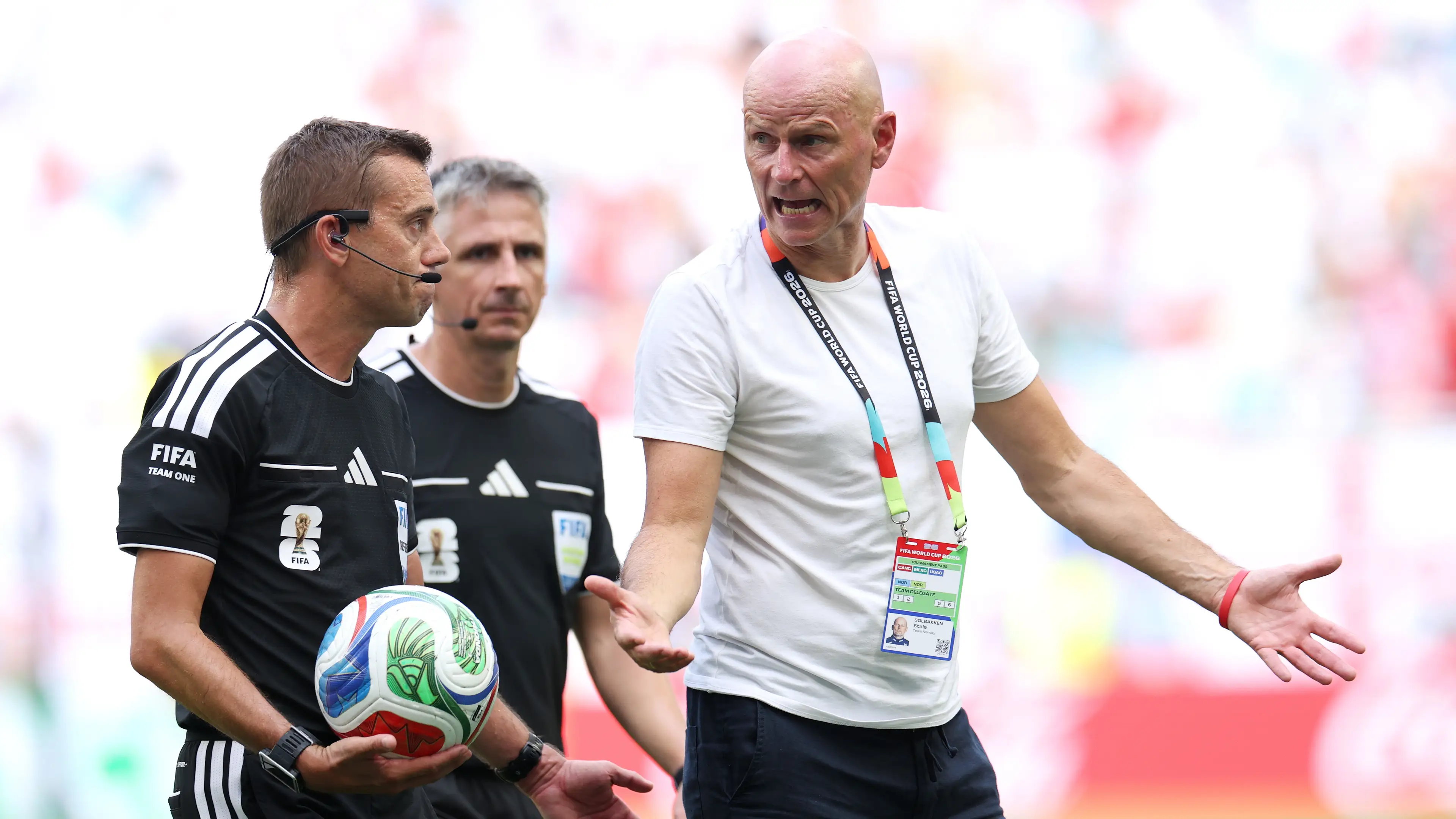
Norway head coach Stale Solbakken has revealed what referee Clement Turpin said about Jude Bellingham's controversial equaliser for England in their World Cup quarter-final clash.
For starters, Norway feel Bellingham's equaliser in the 47th minute should have been disallowed.
They believe the ball struck one of the spidercam wires that is suspended above the playing surface in the build-up to the goal, which altered the trajectory of Norway goalkeeper Orjan Nyland's goal kick.
According to the IFAB Laws of the Game, if the ball strikes a ceiling or a fixture hanging over the pitch, such as a cable or overhead camera, and remains inside the field of play, the match must be halted.
Advert
In fact, had it been determined that the ball touched the wire, the goal would have been disallowed and play restarted with a drop ball.
FIFA has since explained why the goal was allowed in a statement.
"Before England’s goal in minute 45+2 against Norway, the sensor in the Connected Ball showed no peak in the 'heartbeat of the ball' when in the air, and therefore no evidence that the ball touched the overhead wire and changed the movement of the ball," they said.
However, Norway head coach Stale Solbakken was far from convinced with the decision. Shortly after Turpin had blown for half-time, he could be seen confronting the French official.
Speaking in his post-match media duties, Solbakken revealed what Turpin said to him about the call.
“He said that he didn’t see it himself and that he didn’t get any message that it actually happened,” Solbakken said.
“Since FIFA says that there was no touch, he can’t do anything about it. But the ball fell down straight in front of the bench, so it did. Everyone saw what happened. I think it’s pretty clear that it did. It was a strange thing.
“I can sit here and cry but I don’t want to do that. We have done everything we could – the players have been phenomenal throughout the tournament. OK it was bizarre but it’s part of football and why it is the best sport in the world, because things like that can happen. We have to accept it.
“It was unlucky for us. The ball fell straight down from the sky, so it takes this direction. It became a misunderstanding among our players, and it was a bad moment for us. We can’t do anything about that.
"I don’t think we will play the game again," added Solbakke. "So that’s how it is.”
BBC's official 3D replay of the wire incident has become huge talking point
A clip taken directly from the BBC's 3D replay viewer, which is powered using FIFA's official tracking and replay technology, appears to show that the ball makes contact with the suspended cable.
However, VAR did not intervene and Bellingham's goal stood to make it 1-1.
Speaking on Fox Sports about the incident, former Premier League referee Mark Clattenburg said: “VAR can interfere if that contact of the ball on the camera cable is part of a reviewable incident.
"An attacking phase of play leading to a goal is part of the VAR reviewable incident. It should have been picked up by the VAR.”
Topics: England, Norway, FIFA World Cup
 Jack Kenmare