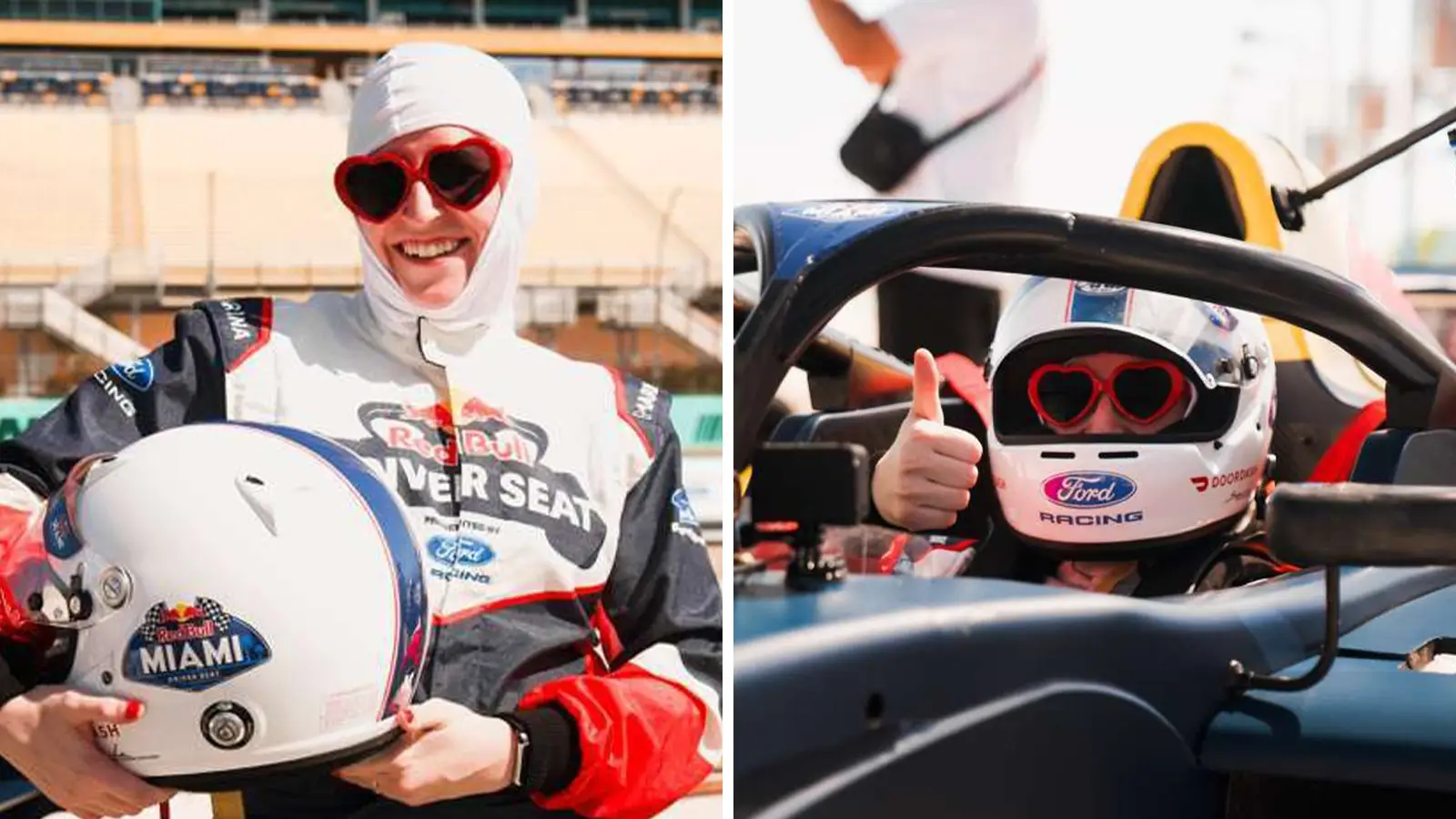
I had four laps in a Red Bull F4 car and now I'm convinced I'm F1 ready

The moment I realized I ignored my husband's advice, it was too late. I was already strapped into the six-point safety harness of a Formula 4 open-wheel race car, holding an umbrella over the cockpit and trying to angle a leaf blower to rocket air directly into the silver of my face visible in my cracked helmet.
“Don't be first out on track,” he'd told me. “Let someone else warm up the tires.”
That way, he said, I would be less likely to crash.
Reader: I was lined up to be the very first driver on track that day, set to conquer the high banks and twisting turns of Homestead-Miami's infield road course with a vague idea of how to drive a manual transmission and absolutely no experience in a race car. Temperatures were cresting 90°F, but the moment I remembered that advice, my blood ran cold.
Advert
Now, I'm no stranger to a fast car. A longtime automotive reporter and motorsport enthusiast, I've had plenty of opportunities to test my mettle behind the wheel of a fast car. But my outing at Homestead would involve several firsts for me. It was my first time at Homestead, and my first time driving on banking.
More critically, it would be my first time behind the wheel of a manual-transmission, open-wheel race car. A race car that had just been competing over at Florida's Sebring International Raceway.
Red Bull had brought me out to the Miami Grand Prix for five action-packed days of energy drinks and motorsport. Along with an invite to see DJ Khaled unveil a special Racing Bulls livery from a yacht - how very Miami - our itinerary featured a little something called “Driver Seat,” but I didn't learn what that entailed until the afternoon before: We'd be driving real-life race cars at a real-life race track. No pressure!
To prepare myself, I consulted with my husband — a consummate sim racer with plenty of experience driving the kind of paddle-shifter cars I'd take out at Homestead. The only difference between us? He's a sim racer who's never driven one of those kinds of cars on track; I'm not a sim racer, so my first experience driving one of these machines would be trying to keep a car out of the wall.
Or, as I would learn, out of the side of the Australian Supercar — basically, an ultra-powerful stock car — that would be taking media members for flying laps around the track while we were out driving our Formula 4 cars. Again: no pressure!
Preparing for the experience
“The hardest part is going to be letting off the clutch,” my husband informed me. “Don't just dump out of it. You have to lift off slowly.”
Historically, my main issue driving a stick shift was exactly that: lifting off the clutch in order to get the car going. I've been prone to dumping the clutch, stalling the car, and trying not to drown in shame.
The best part of a paddle-shifted race car like the Formula 4 Ligier I'd be driving, though, is the fact that it only requires one lift of the clutch. I'd need to master that slow release if I wanted to get moving, but I wouldn't have to press the clutch pedal again until I slowed to a stop back in the pit lane. Each gear shift would only require me to press a paddle on the back of the steering wheel: Press the right paddle to shift up, press the left paddle to shift down.
The worst part about a race car like the Formula 4 Ligier I'd be driving is the fact that it's a race car, with slick treadless tires, impressive g-forces, and firm brakes. So, even if I got that bad boy moving, there was still a good chance I'd lose grip and go spinning. And that chance would grow even greater on cold tires and unused brakes. Hence why I was instructed to let someone else hit the track first.
Yet the moment I arrived at Homestead, every smidge of advice floated out of my mind. All I wanted was to get behind the wheel before I could think too hard about things and cause the adrenaline vibrating through my system to morph into the icy dread of anxiety.
As other media members grabbed a Ford Mustang Dark Horse to learn how to drive stick, I headed to a different Mustang — one that would give me a lap of the track with a driver who'd guide me through the ideal gear changes, apexes, braking zones, and general expectations for every corner. I filmed the lap as if I would review any of that information again before I got in the F4 cockpit. In reality, the moment I got out of the Mustang, I walked up to the first F4 Ligier and informed the crew that I was ready to go.
They fitted me into a seat, made sure I could reach the pedals, strapped on a head-and-neck protection device, and answered my questions about logistics. Then they handed me an umbrella for some shade, aimed a leaf blower at my face, and let me know it would be another 15 minutes before we'd be able to take off.
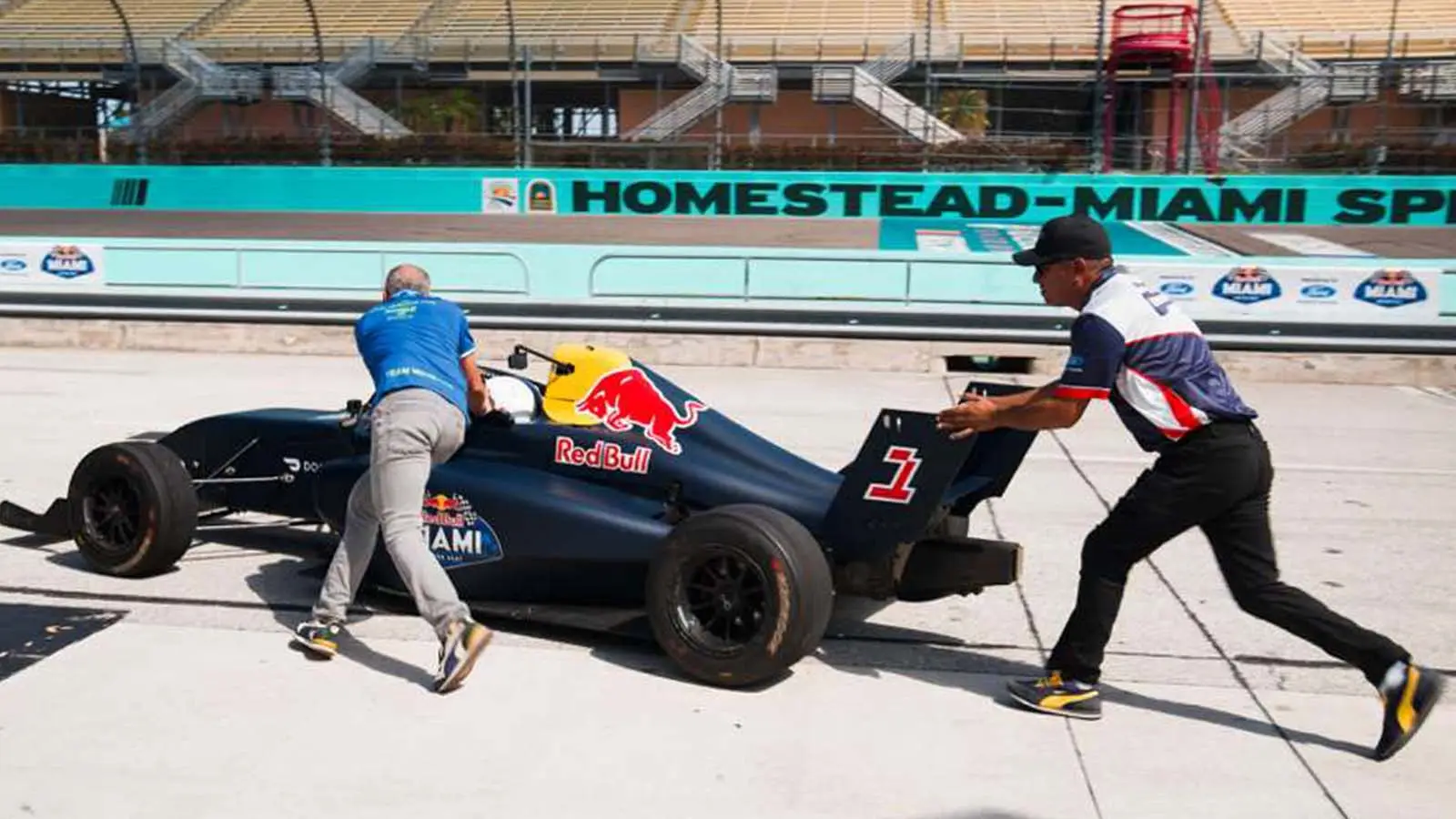
Fifteen minutes, it turns out, feels like an eternity when you're sitting in the cockpit of your first race car. It was at that exact moment my husband's advice returned to mind: Don't be first out. Let someone else warm up the tires.
My pride simply would not allow me to get out of the car and hand it over to someone else — certainly not after I'd had four grown men sweating in the Miami sun to get me strapped into the seat. Instead, I decided to focus on slowly releasing the clutch and pressing the throttle. The very dance I'd failed hundreds of times before.
I depressed the clutch all the way to the floor, took a deep breath, and slowly lifted my foot. The pedal moved easily at first, but then it would catch. The release felt tighter and less controlled; I knew I'd need to be careful of that catch point. Everything in my body wanted me to dump out of it, panicked. So I lifted off, depressed it again, took another breath, and lifted my left foot slowly, pressing the throttle as I lifted off the clutch. Easy. Another breath. Another attempt. Rinse, repeat.
I lost track of how many times I practiced that choreography during the 15 minute interval where the remainder of the media finished their own recon laps. I was even starting to feel confident when the engine roared to life behind me and my crew informed me they were about to push me to a start.
That was another benefit: not having to deal with a standing start. With the clutch depressed and the car already in motion, it would be much easier for the engine to catch when the time came to lift off the clutch and press the throttle. Or, as the crew phrased it, when it was time to “go, go, go!”
READ NEXT: Isack Hadjar reveals motorsport series he's tempted by after F1
Finding comfort in an F4 car
With a squirt of the gas and a gentle lift off the clutch, the car juddered to life. As I neared the end of the pit lane, I shifted up to second gear. It was not a smooth transition — I was too keen, and my revs were off — but I didn't have time to beat myself up about it. I was following a Ford Mustang Dark Horse lead car, and it was clipping the apex of the first turn and launching off into the distance. Now, it was up to me to catch up.
As we increased speed, I was pleasantly surprised that the car was almost easy to drive, at least when compared to some of the track day experiences I've had in the past. Formula 4 cars, our instructor repeated, were designed for literal children. Because of that, they're fairly stable, straightforward machines. When I increased speed again, a green light would pop up on my steering wheel to inform me when it was time to shift up into a higher gear. By the end of the warm-up lap, I was comfortable with the concept of shifting both up and down using both the light and the noise of the engine revs.
It helps that F4 cars only have about 150 horsepower, which is frankly pedestrian compared to the 1,000 horsepower of a Formula 1 car or the 670 horsepower of the Corvette Z06 I'd tracked in the past. There was almost no travel in the brake pedal, encouraging you to really step on it when you were coming to a stop. The steering wheel had very little travel, which meant my every input, no matter how small, was met with a firm and immediate — but not touchy — response.
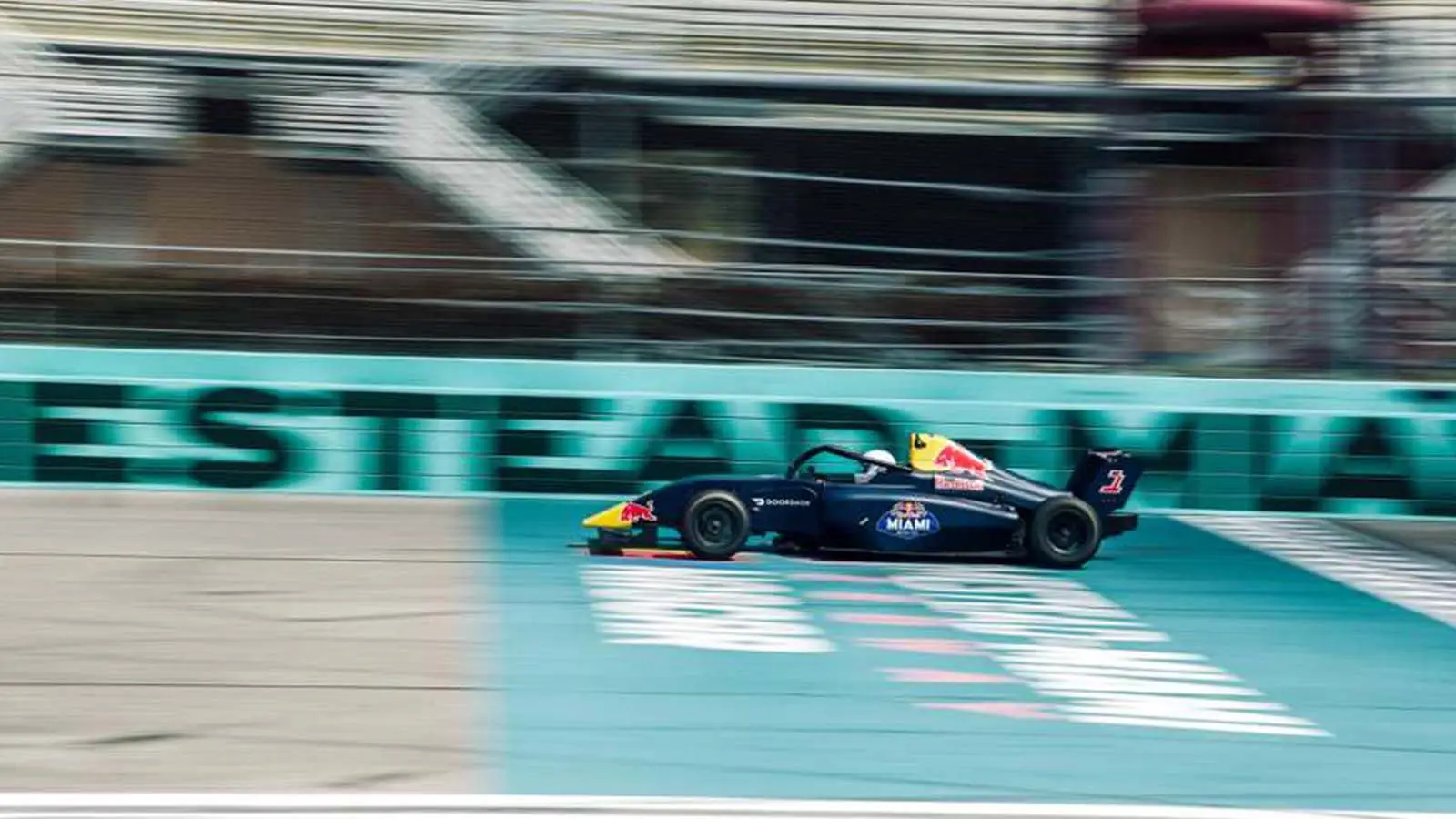
Honestly, it felt pretty comfortable! By the end of my second lap, I wasn't thinking about the mechanics of driving that specific car anymore. I was totally focused on gaining speed and following the racing line.
But all too soon, it was over. I was on the cusp of reaching flow state when the Mustang guide car pulled into the pits, and I had no choice but to follow… and try not to panic because it was time to remember the slow-down procedure, which I had kind of ignored in favor of focusing on actually getting started. It involved slowing the car with the brake, pressing the clutch, dropping down to first gear, then coming to a complete stop. I am not confident I followed those instructions in their proper order.
I was positively convinced that I could have spent the rest of the day in that F4 car, turning one lap after another until it felt like second nature. As I came to a stop, I was also convinced that I'd hop back in line as soon as possible and go out for a second round.
Those turned out to be big dreams, because as soon as I stood up, I started shaking. The adrenaline had worn off and reality was sinking in. I'd just driven a literal race car on a literal race track!!!
As I decompressed with a bottle of water and watched my colleagues head out for their own laps, I couldn't help but think it was kind of insane that Red Bull was letting us do this. F4 cars aren't exactly the pinnacle of technology, but they do cost tens of thousands of dollars, and none of us heading out there had any experience.
But honestly, that's the Red Bull way. Throw yourself into something a little terrifying and see what happens.
And what happened? Red Bull turned me into a race car driver in just four laps.
SPORTbible was invited to the Miami weekend by Red Bull to celebrate the launch of their latest Summer Edition, Citrus Zest.
 The SPORTbible Team