
Sprinter 'faster than Usain Bolt' issues statement after two-year ban verdict

A sprinter who once claimed he was faster than Usain Bolt has issued a statement after being banned from competition for two years.
American star Fred Kerley, who won silver in the men's 100 metres at the Tokyo 2020 Olympics and bronze at Paris 2024, was given a two-year suspension on Friday over several anti-doping whereabouts failures.
He has also had his competitive results from December 6, 2024 to August 12, 2025 annulled from the record books, and has been disqualified from any titles and prize money earned during that period.
Kerley must also pay $4,000 to World Athletics in legal fees and other expenses.
Advert
The ban is backdated to the date of his initial suspension, meaning he will be ineligible to compete until August 2027.

Kerley blamed technical issues with the United States Anti-Doping Agency app for his first missed test on May 11, and the Doping Control Officer for subsequent missed tests on December 6 and 7. He did not contest another missed test on June 13.
But a Disciplinary and Appeals Tribunal described Kerley as 'negligent and, to a certain extent, reckless' over the first three whereabout failures. The December 7 failure was not judged as the first three failures were enough to warrant a ban.
The Athletics Integrity Unit (AIU) stated: "Unfortunately, sophisticated doping substances may only be detectable within an athlete's sample for a few days or even hours after administration.
"Anti-doping organisations need to be able to test athletes without notice on the day and hour of our choosing, otherwise anti-doping programmes will not work, and dopers will easily avoid detection.
"Whereabouts rules are therefore fundamental to the integrity of sport and must be respected."
Kerley has now released a statement on the matter, writing on Twitter: "AIU, tell the world the truth. I am a clean athlete. I have never tested positive for anything in my life. Stop playing with my name."

The 30-year-old was banned for whereabouts failures, and was under no suspicion of having consumed any illegal substances.
He then claimed he was 'buying a racing horse', before sending a message directly to the AIU's account: "Why my name still pinned to yall page and yall just caught someone actually on drugs. I am DISTRESSED."
"In recent years, it often feels like the focus has shifted toward whereabouts violations rather than actually catching athletes who are using banned substances," he added.
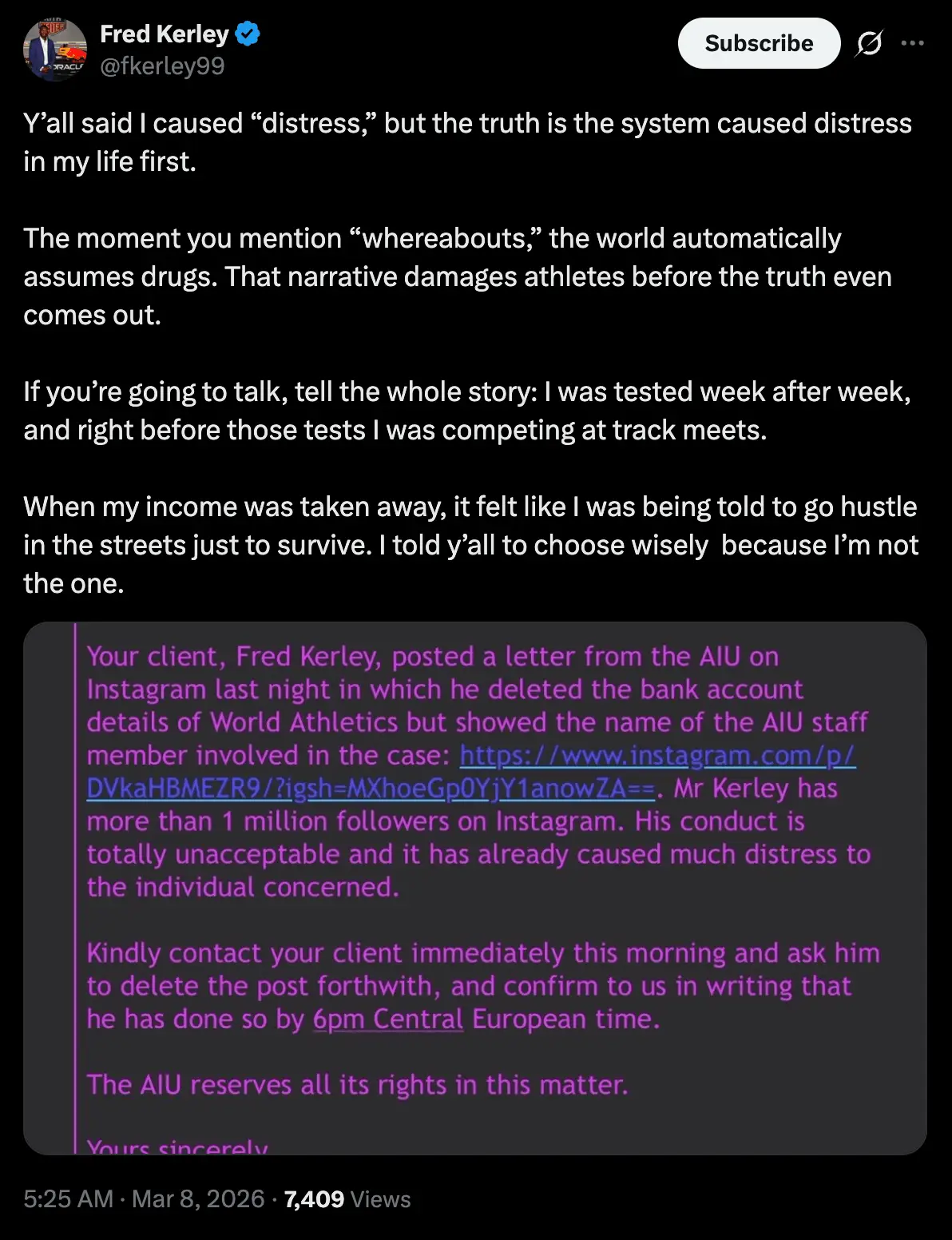
Kerley then claimed that he had received a legal notice after publishing the name of an AIU staff member involved in his case.
"They text my lawyer and said I am caused [sic] distress," he wrote.
"But they already destroyed my image with accusations and a two-year ban. Do the right thing now because the truth is about to be seen by the world."
In September, Kerley became the first track athlete to sign up for the controversial Enhanced Games, which permits the controlled use of banned performance-enhancing substances.
The American said he wanted to become 'the fastest human to ever live', stating: "The world record has always been the ultimate goal of my career.
"This now gives me the opportunity to dedicate all my energy to pushing my limits and becoming the fastest human to ever live."
The 100-metre world record has been held by Usain Bolt since 2009, when the Jamaican set a time of 9.58 seconds at the World Athletics Championships.
Kerley's personal best over the same distance is 9.76, which he ran at a meet in Eugene, Oregon in 2022.
In that same year, the American posted a video of himself completing a sprint over 150 metres, after which he claimed he had set a time of 14.01 seconds - 0.34 seconds faster than Bolt's existing record.
Topics: Usain Bolt, Athletics, US Sports
 Ryan Smart